_edited.png)
The 36th Division Archive
%20-%20Copy_edited.png)
Corporal Henry S. Phillips
Scout
E Company, 2nd Battalion, 143rd Infantry Regiment


Henry S. Phillips was born in the riverside town of Boothwyn, Pennsylvania in 1919. He and his family, however, moved to Nether Providence while he was an infant, another small town just west of Philadelphia along the Delaware River. Henry grew up there alongside his brother while their father provided for the family by running a local grocery. An active blonde-haired blue-eyed boy, he attended Nether Providence High School in Wallingford and excelled academically.

Henry's military souvenirs.

Henry's E Company collar brass, 143rd Infantry unit insignia, Combat Infantry Badge, and campaign ribbons.

Patches cut from Henry's dress uniform.
Henry's military souvenirs.
After graduating, he went on to West Chester State Teachers College where he began studying to become a teacher. He was involved in several extracurriculars, such as the photography and government clubs, and was extremely active in his outside community. Despite being ethnically Jewish, his family were Methodist converts were and quite involved in their church, Siloam Methodist. Henry served there as a boy scout leader and a Sunday school teacher. He was serving in these roles when war broke out and only a few months later, on June 3, 1942, he was drafted into the United States Army.
Henry went through basic training at Camp Blanding, Florida, where he qualified as an infantryman. By that fall, he was given his permanent assignment as a scout in E Company, 2nd Battalion, 143rd Infantry Regiment, 36th Infantry Division. By this point the division was undergoing its final training at Camp Edwards, Massachusetts, and held several mock amphibious landings. A moment of relief from Army life came on November 7, 1942, when he went home to marry his lifelong love, Wilda. The pair spent some time honeymooning in New York City before they returned to Camp Edwards.

Henry enjoying a favorite pastime, fishing.

Henry's high school yearbook entry.
Henry enjoying a favorite pastime, fishing.
Henry said goodbye to his bride and shipped out with the rest of the 36th Division to North Africa on April 2, 1943. They arrived a few weeks later and spent the next several months undergoing even more training in theater, watching the conquest of Sicily while many of the long-serving T-Patchers wondered when they would finally see combat. It was less than two months later that the time arrived.
On September 2, 1943, Henry and his company loaded up aboard the transport U.S.S. Stanton APA-69 while it was docked in North Africa. Within three days, the entire 36th Division had been funneled into transports and joined a large convoy of Allied ships steaming towards the coast of Italy. Once they were at sea, it was revealed that the division would be making the invasion of the Italian mainland as the first American troops to set foot on the European continent. The invasion of Salerno was underway.
The division’s part in the invasion was to take the beach of Paestum, an ancient Roman village south of Salerno. Henry and the rest of 2nd Battalion were tasked with landing on Red Beach. In the early morning of September 9, around 0415, the battalion was called to debarking stations, climbing down rope ladders into their LCVPs. After a dark and bumpy ride ashore, the battalion hit the beach. It was a scene of chaos. The Germans were prepared for the landing, targeting all of their guns on the strip of sand being filled with 36th Division troops. Artillery, mortars, machine guns, and all types of fire immediately poured into the landing zone of Henry's battalion. The T-Patchers sought cover in ditches, behind rocks and trees, or anywhere else that gave them some shielding from the enemy. E Company was largely scattered as artillery split the men into small fighting groups, each making their way inland according to their own pace and levels of encountered resistance. The fighting continued in this manner for several hours until the evening when 2nd Battalion was eventually able to assemble in a position near Carpaccio. Henry had officially received his baptism of fire.

Assaulting the Salerno beachhead.
Assaulting the Salerno beachhead.
The next two days were comparatively quiet for Henry’s battalion as the fighting shifted to other elements of the division. On September 10, 2nd Battalion set up observation posts on nearby Monte Soprano, one of the large hills overlooking the beachhead, and along a neighboring valley. By day three of the invasion, 2nd Battalion was put into division reserve. There was word from German prisoners that the 16th and 26th Panzer Divisions were preparing a counterattack, but division leaders expected this to come near Altavilla, a heavily contested area to the north. Henry’s battalion spent September 11 mostly sending out additional patrols and scouting the town of Cicerale, on the southern edge of the division line.
In the late evening of September 11, 2nd Battalion traveled to the far north of the division line, northeast of Altavilla where the 142nd Infantry Regiment was digging in. By the early morning, a large German counterattack was launched against Altavilla, tying up the entire 142nd Infantry and portions of the other regiments of the division. At noon, 2nd Battalion was ordered to hold defensive positions northeast of Persano, a small farming town in the rolling flatland north of Altavilla on the far left of the division flank. The battalion was to relieve elements of the 45th Infantry Division there, which were needed further up north in the expanding Allied beachhead. Other battalions of the 143rd Infantry were sent to Altavilla to support the 142nd in its defense.

Status of the Salerno beachhead as of September 11, 1943
Status of the Salerno beachhead as of September 11, 1943
2nd Battalion moved to an area of farmland along the Persano corridor. The land was bordered by two rivers, the Sele to the north and the Calore to the south. Bridges across both had been destroyed, but a major road leading to the sea traveled between them and through Persano. With Allied command worried that the Germans would use this route to try and split the American forces, the 45th Division to the north and 36th Division to the south, 2nd Battalion was ordered to dig in and plug the gap. They were assured that elements of the 45th Division would be on their flank, on the western bank of the Sele River, to provide additional support in the somewhat isolated area.
By the early hours of September 13, 2nd Battalion had moved in and created a defensive line. G Company was placed in a forward outpost line, facing inland, with the main line of resistance a few hundred yards behind it. In that line, E Company held the right flank and F Company the left (northernmost) flank. The area was crossed with hedgerows, as it was farming country, and the battalion quickly realized it was too much land for a single battalion to hold. The battalion commander, Colonel Charles H. Jones, told G Company to withdraw through the main line and cross the Calore should any major attack occur. This way, the rest of the battalion could hold off the Germans before similarly retreating across the river to a more defendable position. Much of this plan relied on continued assurances that the 45th Division would continue holding and attacking across the Sele River to their north, relieving any potential pressure from German forces.

Troops of the 143rd in Italy
Troops of the 143rd in Italy
E Company was commanded by Captain James Bond, of Waco, Texas, who decided to make the company’s command post in a wooded gully. Henry and the rest of the men spread themselves out along the hedgerows, making fighting positions out of whatever decent terrain they could find. One of the main concerns of the battalion was its anti-tank capabilities. Rumors spread that forty enemy tanks had been spotted moving in a nearby area. 2nd Battalion had a single platoon of anti-tank guns and a platoon of M7 Priests to stop any armored assault. For the line infantrymen of E Company, they had nothing more than their rifles, carbines, and machine guns.
The morning of September 13 was relatively quiet. The battalion quickly realized, however, that the 45th Division had not lived up to its promises. Repeated contact patrols sent out by 2nd Battalion failed to find any signs of them. Radio calls to VI Corps headquarters, which the battalion was temporarily under, were met with only empty assurances that the 45th Division troops had to be there somewhere. As far as 2nd Battalion was concerned, however, they were probably alone.
At 1300, scouts first sighted German panzers across the Sele River on their left flank. Some scattered artillery began falling in the area and sounds of fighting could be heard in the distance. The rumbling of dozens of engines filled the air as the GIs of 2nd Battalion waited anxiously in their positions. At 1500, the battle began.

Map of the German armored attack against 2nd Battalion
Map of the German armored attack against 2nd Battalion
Several dozen German Panzer IVs, supported by halftracks and armored cars, hit G Company in the first line. Tank cannon, machine gun, and rifle fire began pounding into the hedgerows where the line stood. Standing to their orders, the men of G Company put up light resistance before falling back, withdrawing towards the battalion command post and the reorganization point across the Calore River. They streamed through E and F Company while the German armor slowly advanced.
Accounts from members of E Company recall how German artillery and mortar fire “literally churned the ground” around their positions. The two 57mm anti-tank gun crews supporting E Company tucked and ran as soon as the panic set in, and one of the M7 Priests acting as anti-tank support decided to wander off towards the battalion command post. The first German to make his way into E Company’s lines crawled through an opening of a hedgerow with a light machine gun. Unfortunately for him, one of the company’s .30 machine gun teams had spotted him, opening up and causing his head to “explode.” Up and down the line, German soldiers and tanks working in small combat teams began hitting the scattered platoons of the company.
Some men tried fighting back but the company’s small arms were simply too inadequate to do anything to the overwhelming armored force. One tragic story described a rifleman knocking out a panzer’s tracks with a rifle grenade, only to be immediately captured by the tank’s crew and forced to put the track back on. E Company’s command group surrendered after a Panzer IV broke down a length of hedgerow and pointed its cannon and machine gun directly into their shallow trench. The group, armed only with carbines and Garands, put white cloth on the end of a bayonet and gave up.
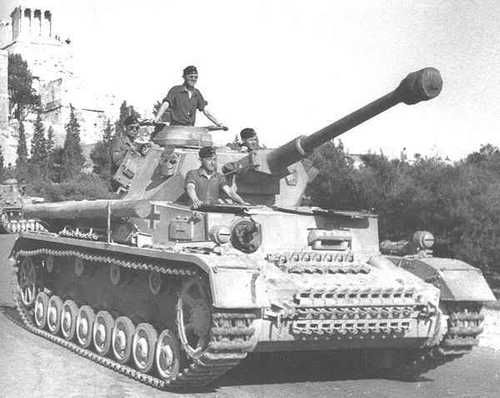
A German Panzer IV in Italy
A German Panzer IV in Italy
At some point in the fighting, Henry was captured much the same way. The entire battle took roughly two hours, with each small group of men led towards the rear as they were taken by the Germans. At this point it became clear just how outnumbered they were, as columns of German trucks, halftracks, and armor spread along the roadway leading from Persano. Unfortunately, the 45th Division had indeed left its post. The German force had managed to come through Persano while another group flanked around from the east, pinching 2nd Battalion with nowhere to run. While G Company had mostly made it across the river by the time the Germans closed in, the rest of the battalion was cut into small groups and slowly captured throughout the afternoon. With barebone anti-tank defenses, most GIs were faced with taking on the several dozen panzers with nothing more than their rifles and grenades. Lieutenant Julian Quarles, one of the surviving officers, described the scene:
It was not a defensive position, and never before or since did I see a combat unit placed in such a vulnerable position, with the enemy in front of it and nothing on either side or behind it. Considering the Battalion had no prior combat experience, it was like a high school football team facing the Dallas Cowboys.
2nd Battalion of the 143rd Infantry Regiment reported roughly 500 casualties that day, with over 400 of those being taken prisoner. Only nine officers and 325 enlisted men made it back to the division lines that night, reporting of the absolute slaughter that had occurred. The division coined the date “Black Monday.” They had been in combat less than five days.

Henry among those missing in the E Company morning reports.

Henry on the list of E Company men missing in the 143rd's September 1943 casualty report.
Henry among those missing in the E Company morning reports.
Henry and his comrades remained in place that first night among their captors. With no American troops around, the Germans felt little need to rush them away. The enlisted were put into a large old barn and told to sleep. Postwar accounts from the T-Patchers described the Germans as rather hospitable and professional after their initial capture. The next morning, once daylight broke, the group was marched back to a prison pen behind an old house. Allied fighters flew overhead, wagging their wings in acknowledgement of the prisoners before zooming off to safety. Eventually, the men were put into an open-air Italian prison near Naples and loaded aboard a train bound for Germany
The trip to Germany was far from desirable with men cramped into a “forty-and-eight” boxcars and given only a few pieces of bread to last them the journey. Sanitary conditions were nonexistent, with men defecating either in helmets or a single bucket provided for each car, which had to be cleared out the window regularly. After traveling through several processing centers, Henry eventually made it to Stalag II-B, located near Hammerstein in Poland. After having his picture taken, he was assigned a serial number, 21164, and given a prisoner’s dog tag. Henry had arrived at his new home for the next sixteen months.
Stalag II-B already housed tens of thousands of Allied prisoners of war from all countries. The first Americans had arrived only a month before Henry, who likely reached the camp in late September or early October as one of the first batches of prisoners taken in Italy. The Americans were kept in their own compound, separated from the others by layers of barbed wire fences. The barracks, basic and dilapidated, contained three-tier bunks which were overcrowded with prisoners. As more and more Americans began to arrive, however, the Germans began outsourcing the prisoners into independent work “kommandos.”

Members of the 143rd infantry in a "Kommando" at Stalag II-B

Members of the 143rd infantry in a "Kommando" at Stalag II-B
Members of the 143rd infantry in a "Kommando" at Stalag II-B
Kommandos were groups of roughly thirty to forty prisoners sent out from the main camp to perform labor for the German war effort. Throughout the fall of 1943, nearly 200 Kommandos were established across the countryside near the camp, some as far as a hundred miles away. Because most Americans brought to II-B were enlisted, the Germans planned to use them for forced manual labor. The Geneva convention permitted forced labor for lower ranking enlisted, like Henry. Most Kommandos performed agricultural work, tending and plowing fields to bolster the Reich’s food supply. It was long and thankless work, and is likely what occupied most of Henry’s time over the next year and a half.
Beyond the difficulty of the work, Henry was subject to one of Stalag II-Bs most violent periods. According to American intelligence reports during the war, treatment at Stalag II-b was “worse. . . than any other camp in Germany established for American [prisoners] before the Battle of the Bulge.” Guards were harsh, brutal, and cruel, regularly beating the men on Kommandos and ignoring provisions of the Geneva Convention. During Henry’s first three months at II-B, eight Americans were shot and killed by guards while serving in the Kommandos.
Henry most likely worked day in and day out at one of the II-B subcamps from October of 1943 to January of 1945, watching the war go by behind barbed wire and in the fields of occupied Poland. Towards the end of January, however, he likely was one of the thousands of prisoners put onto a forced march into Germany. With fear of Russian troops approaching, the Kommandos of Stalag II-B were evacuated deeper into the Reich where they would be relocated in new camps. For men like Henry, undernourished and with little fresh clothing, this meant a long, brutally cold march through northern Germany in the midst of snowstorms and freezing temperatures. Many accounts describe these marches as some of the worst experiences of American prisoners of war as they walked hundreds of miles with little to no food.

A drawing depicting one of the many forced marches of Allied POWs during the winter of 1944 to 1945.

A drawing depicting one of the many forced marches of Allied POWs during the winter of 1944 to 1945.
A drawing depicting one of the many forced marches of Allied POWs during the winter of 1944 to 1945.
It is unknown which camp Henry ended up at, but American records show he was formally liberated on April 12, 1945. Henry had been a prisoner of war for nineteen months. Like most POWs, he was processed and slated for immediate evacuation back to the United States. A week after the war in Europe ended, on May 15, 1945, he set sail, arriving in New York shortly after. He was given sixty days of leave, spent with his wife and loved ones, before returning to Atlantic City, New Jersey for Army reclassification for additional service. Like other prisoners of war, he did at least receive a bump in grade, to corporal. Thankfully, the war came to a close before he could ever be reassigned. Henry received his final discharge from the Army on October 10, 1945, with four days spent in combat and 577 days as a prisoner of war.
After his discharge, Henry returned home and settled with his wife in Chadd’s Ford, Pennsylvania. After finishing up his teaching degree, he put it to good use by becoming a high school history and engineering teacher. He spent a long career in education, serving his longest post as a guidance counselor for the Delaware County public schools. He and his wife never had children, but made a lasting impact on countless young people around them. Despite the horrors he endured as a prisoner of war, Henry was proud of his military service and hung these artifacts in his home for many decades. Of all the items he kept, his American and German dog tags represent two of his only possessions that made it alongside him through his year-and-a-half of incarceration. Henry passed away on September 9, 1992, in Boothwyn.

A local newspaper article about Henry's liberation.

A local newspaper article about Henry's liberation.

Henry's grave
A local newspaper article about Henry's liberation.