_edited.png)
The 36th Division Archive

Private First Class Richard T. Valentine
Rifleman
A Company, 1st Battalion, 143rd Infantry Regiment


Richard Thomas "Tommy" Valentine was born in 1924 in St. Mary’s, Pennsylvania, a small town in the heart of the Pennsylvania Wilds. He was the middle of eight siblings, all of whom were provided for by their father, a carpenter in construction work, and taken care of full time by their mother. He grew up like any rural American kid, playing sports, exploring the wilderness, and watching as the quiet town thrived, reliant upon its natural resources and carbon graphite manufacturing industry. He attended St. Mary’s Public High School where he was an academic and an athlete, serving on his student council and playing on the football team throughout his years. In the latter half of his schooling WWII broke out, leading him to take up a position at the Stackpole Carbon Company after graduating in 1942, as it was an essential war industry.
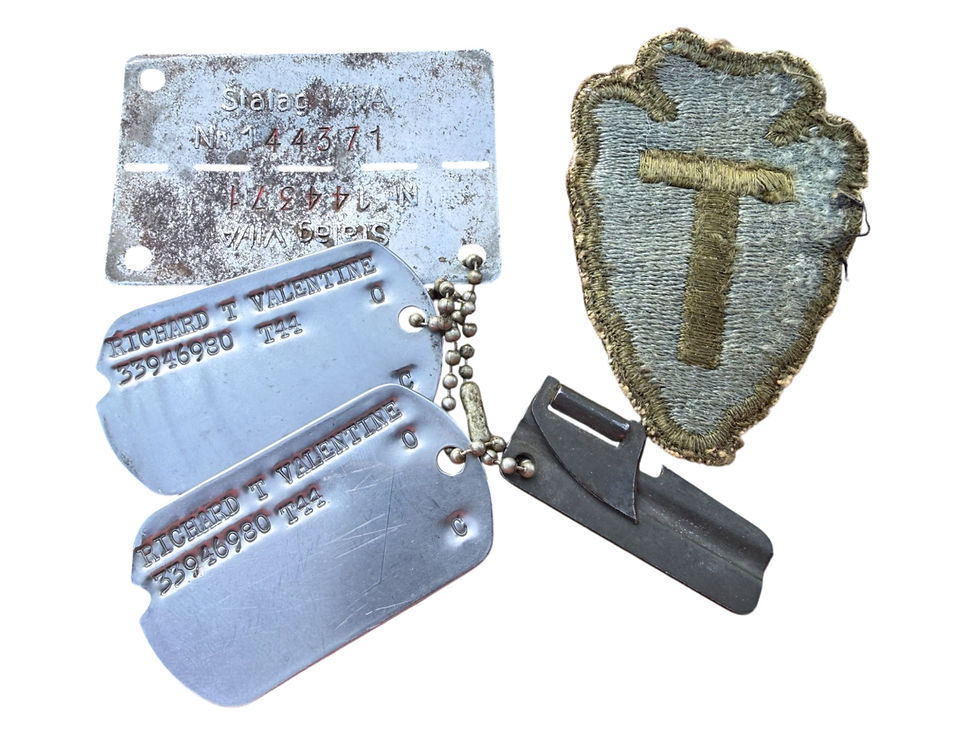
Valentine's American and German POW dog tags.

Valentine's American and German POW dog tags.

Valentine's American and German POW dog tags.
Valentine's American and German POW dog tags.
In May of 1944 Valentine received notice that he had been drafted into the U.S. Army. After his parents threw a large going-away party for him, he left his hometown on June 2, 1944. He traveled all the way down to Camp Blanding, Florida, where he was put into the Infantry Replacement Training Center and underwent basic training throughout that summer. He graduated in the early fall as a rifleman and was quickly slated to join the batches of infantry heading overseas for the European theater. He sailed out of Fort Meade on November 14 and reached Europe only a few weeks later, filtering into the 2nd Replacement Depot for his permanent assignment.
On December 9, 1944, Valentine joined A Company, 1st Battalion, 143rd Infantry Regiment, 36th Infantry Division alongside nine others as a replacement rifleman. The 36th Division, a well-seasoned and veteran regiment of Italy and France, had just finished a grueling months-long campaign pushing through the Vosges mountains. Only days before Valentine joined the division it had broken out into Alsace just north of Colmar, facing a determined German defender hoping to keep the division on the Alsatian Plain and away from the Rhine River and the German heartland. Since the start of December the division had been engaged in heavy fighting across the towns of Alsace between Colmar and Selestat, pushing Germans back and forth between small villages while the 143rd Infantry desperately worked to take the high ground, Hills 351 and 393, which sat on the plain just northwest of Colmar overlooking Riquewihr.

Valentine joining A Company on December 9, 1944.

Valentine's 1942 yearbook photo.

Valentine's draft registration card.
Valentine joining A Company on December 9, 1944.
Valentine’s battalion had spent the days prior to his assignment around the town of Mittelwihr, which was just north of the two major hills. German troops had fought desperately to retake the town as it was a strategic center of the entire 36th Division line, and the key to holding the nearby high ground. The battalion was tired. Its men showed signs of fatigue and its officers began worrying about their combat effectiveness. The German troops they were up against were fresh reinforcements, with mixed Heer and SS troopers usually with Eastern Front experience. Casualties were mounting, so replacements like Valentine were greatly welcomed.
Valentine met A Company on December 9 during its strong push against Mittelwihr. A Company attacked from the west of the town while C Company came from the east and C Company supported with fire from the top of Hill 251. Around noon, both companies in the attack reached the interior and began clearing building by building of German soldiers. Snipers, hidden machine guns, and counter artillery fire plagued the troops all day. The Germans hoped to hold the town at all costs.
By the midafternoon, Mittelwihr was clear so A Company, along with M7 Priests from the Cannon Company, began driving south to the neighboring town of Bennwihr, which was somewhat integrated into Mittelwihr through a connecting roadway. C Company took up the left flank in support, but both companies quickly became bogged down under intense enemy fire. Knowing Mittelwihr was at risk, Germans had bolstered the sister village with armor and infantry. After hours of hard fighting, and forty-five German prisoners taken, Valentine and the battalion dug in on the outskirts of Mittelwihr and called for artillery fire to keep the Germans enjoying the protection of Bennwihr on their toes. The Germans eventually responded in kind with a series of Nebelwerfer rocket fire back into Mittelwihr.

A map showing the situation of A Company and the overall defense of the 36th Division during Operation Habicht. The specific placements on this map date to the attack on December 14, 1944. Note A Company's position holding Mittelwihr prior to its capture.

An M7 Priest of the 143rd Infantry's Cannon Company positioned near Ribeauville firing in support of the infantry on December 9, 1944.
A map showing the situation of A Company and the overall defense of the 36th Division during Operation Habicht. The specific placements on this map date to the attack on December 14, 1944. Note A Company's position holding Mittelwihr prior to its capture.
Most of December 10 was spent in foxholes as the M7s traded fire with German tanks and artillery, one even scoring a direct hit on a Panther just to the south. Division headquarters tried sending Sherman tanks of the 753rd Tank Battalion to join the force, but the Germans launched a massive artillery barrage in response, forcing the armor back. December 11 was basically the same, although the 3rd Battalion of the 143rd Infantry used the hazy fog and mist to slowly creep into the edge of Bennwihr from another flank, taking a few houses by mid-morning. The Germans had placed heavy armor along the main street in Bennwihr, however, discouraging any major assault. 3rd Battalion gradually seized additional buildings until the tank and other German troops in the southern part of Bennwihr forced them to halt.
December 12 marked a major shift in the battle for Alsace. Little did the GIs know, but this day was the start of Operation Habicht: the German plan to launch a major assault against the 36th Division in hopes of smashing through the 7th Army line and distract from the upcoming offensive in the Ardennes planned to begin four days later. Telling of the weight the German high command placed on the operation was the placement of Reichsfuhrer-SS Heinrich Himmler to oversee the attack.
Heavy vehicle traffic in and out of Colmar through the night concerned the American soldiers, but it was not until German troops infiltrated the 36th Division line at Beblenheim, the town just north of Mittelwihr, that the intent became clear. German troops suddenly launched an attack from the southern edge of Bennwihr against the 3rd Battalion of the 143rd, forcing the entire battalion to commit itself in heavy action in order to keep their foothold in the town. Valentine and 1st Battalion prepared themselves in Mittelwihr, aware that German troops could break through and reach their positions from the north or south at any moment. Eventually, a lighter German attack did try to press into Mittelwihr around 1330, but 1st Battalion was largely able to fend it off after a few hours. For a newbie like Valentine, it was a true trial by fire.

Mittelwihr in the distance, from one of the nearby hills.

Mittelwihr being covered by smoke shells from division artillery

Bennwihr after undergoing serious combat.
Mittelwihr in the distance, from one of the nearby hills.
Although the attack stopped once darkness fell, the GIs remained anxious. Reports came in from across the division that German troops were pressing all positions and had infiltrated dozens of spots along the front. The worst news came from the 133rd Field Artillery Battalion in the division rear, who had to fight off an entire German platoon which had snuck behind the lines in hopes of destroying the artillery. Thankfully, the artillerymen beat them off, but not before Valentine and his company were sent to the woods just south of the howitzers to make sure there was no other threat. It was a long, rainy, and restless night.
Early in the morning on December 13, 3rd Battalion of the 143rd was met yet again by an intense German offensive. German troops began infiltrating the Bennwihr defensive line around 0815, requiring tanks and infantry from C Company, which had retained in Mittelwihr, to move in support. It was fierce fighting all day, with infantry and armor from both forces battling it out on the small and compact cobblestone streets of Bennwihr. Valentine and A Company moved back into Mittelwihr to hold that portion of the line, with 3rd Battalion of the 142nd Infantry Regiment to their left, holding Beblenheim, and B Company to their right, on the slopes of Hill 351. Orders eventually came through that 1st Battalion was to move up and relieve 3rd Battalion from the ferocious firefight in Bennwihr, but these plans never came to fruition.
Around 0100 on December 14, fifty German soldiers penetrated through L Company and made their way behind Mittelwihr, launching an attack on A and K Company, which had just started the relief process. The situation was thought to be under control within an hour, but German infiltration parties began appearing from everywhere. By 0430, German troops with Panzerschrecks had knocked out an M7 Priest from Cannon and three jeeps in Mittelwihr, as well as cut the road connecting Mittelwihr and Beblenheim. 3rd Battalion troops in Bennwihr were then heavily engaged. The situation quickly became critical.

American troops stroll through Mittelwihr after the fighting. Note the knocked out Hetzer self-propelled gun in the background.

Dead SS soldiers killed during Operation Habicht in Bennwihr.

An M4 Sherman knocked out in the streets of Mittelwihr
American troops stroll through Mittelwihr after the fighting. Note the knocked out Hetzer self-propelled gun in the background.
By 1050, K Company was ordered to retreat to Hill 351. German troops had surrounded Mittelwihr and completely broken through the 3rd Battalion defensive line. A and L Company remained stretched between Mittelwihr and Bennwihr, desperately trying to form any semblance of organized resistance. It was utter chaos, and Valentine was just one of the many A Company rifleman working his way from house to house trying to keep the Germans at bay. At some point during the fighting, a large group of German tanks, likely Panzer IVs and self-propelled guns, were spotted charging towards the town. One of the A Company scouts who spotted the tanks, Charles Wagaman, was hit by artillery shrapnel and left propped up against a tree, only to be captured by German infantry minutes later. Like Valentine, he was a fairly new replacement to A Company.
The Panzers wrecked havoc in Mittelwihr. One tank pulled up directly in front of the A Company command post around the time the company commander, Lieutenant Albert G. Frost, was moving positions. It opened fire with its machine gun and killed him instantly. This great loss to the company inspired one soldier, Staff Sergeant David Blewett, to stealthily approach the tank before rushing it with hand grenades in either hand. Although enemy machine gun and rifle fire burst around him, he climbed onto the tank and threw the grenades into the turret, killing the crew and setting it on fire. At the same time, twenty-five German soldiers ran into a house across the street. Without hesitating, Blewett launched two white phosphorous grenades into the building, setting it ablaze and forcing the German troops to withdraw. His heroism was an inspiration to all men of the company and characterized the fierce resistance put up by the T-Patchers of A Company during their defense of Mittelwihr. Tragically, Blewett became one of the many prisoners taken after he tried to flank a German machine gun. He was later awarded the Distinguished Service Cross for his actions.
At some point in the early afternoon, Valentine was taken captive by German troops. As the attackers broke A Company into clusters, men were surrounded group by group until a whopping sixty-six Americans had been forced to surrender. By the end of the day, this included three of A Company’s officers, its first sergeant, and nearly two platoons of men, Valentine among them. The company was more than cut in half in a single day. While Mittelwihr fell that day, A Company had put up a fearsome defense.

A Jagdpanzer IV/70A knocked out during the fighting in Mittelwihr, the husk of the town behind it.
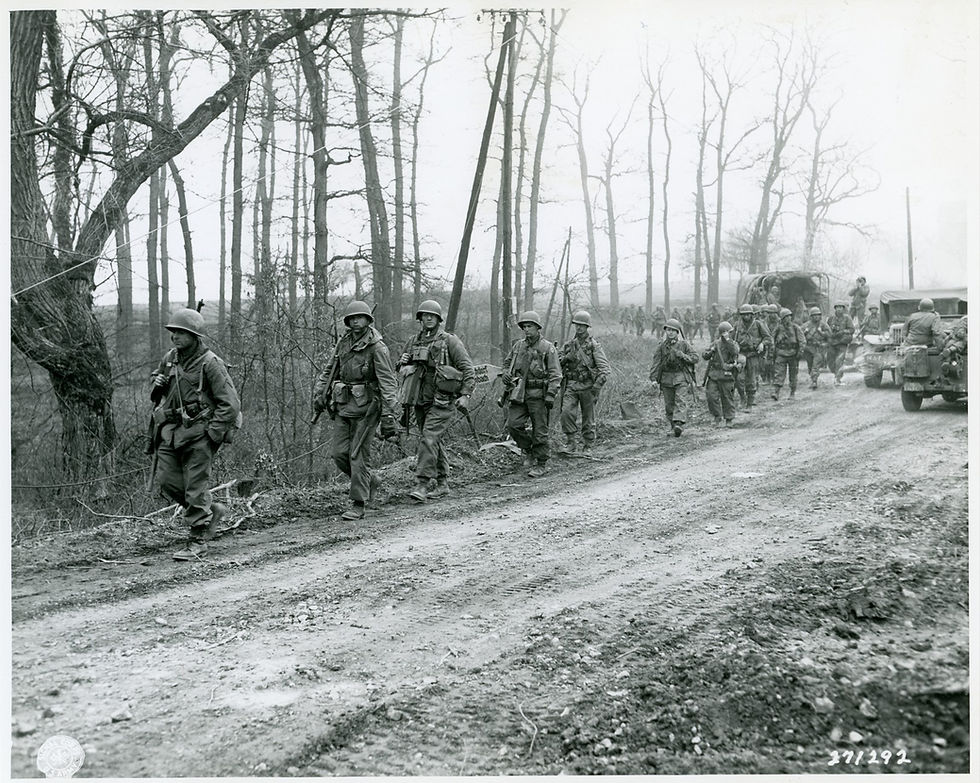
143rd troops on the move.

Mittelwihr after the fighting.
A Jagdpanzer IV/70A knocked out during the fighting in Mittelwihr, the husk of the town behind it.
Valentine and the other prisoners were marched back several miles from the frontline across the Rhine River where they and other prisoners taken during Operation Habicht were all huddled into various barns. Although Operation Habicht stalled in the days after Valentine was captured, German forces streamed most of the 36th prisoners to these barns for about a week. The group was then taken to Villingen where they were quartered in old military barracks for yet another week. Eventually they were finally loaded onto trains for a four-day trip to Stalag VII-A, located in Moosberg north of Munich. Here, Valentine and the other T-Patchers were formally processed and admitted as prisoners of war. As part of this process, Valentine’s photo was taken and he was assigned the serial number of 144371. This was then engraved onto a square prisoner dog tag, which Valentine simply looped onto the chain of his GI-issued tags.
Private William Dennebaum, a rifleman from I Company, 143rd Infantry Regiment, was thirty-three men behind Valentine in line to be processed into Stalag VII-A. He recalled the camp being crowded with American and British prisoners. Conditions were not ideal but the wooden barracks were sufficient to keep the men warm in the cold German winter. Food was extremely poor, featuring ersatz bread filled with sawdust, watery soup, and no meat to speak of. The prisoners tried to keep themselves busy on a nearby athletic field, but the most coveted opportunity was to join a work detail sent into Munich. These details performed a number of jobs, from clearing post-bombing raid rubble to assisting in factory work. The benefit, however, was the ability to trade cigarettes and soaps from their American Red Cross parcels for bread, sausages, books, or any other amenity that would make life more bearable for the prisoners. There was little violence from the guards, although Dennebaum distinctly recalled one Russian corpse hanging from the wire fence after he was shot trying to escape.
While some of the 36th prisoners from Alsace, like Wagaman, were moved into other camps, Valentine remained in Stalag VII-A. Although he would not know it until the end of the war, his brother, Private First Class Henry Valentine of the 8th Infantry Division, was killed during his first few weeks of imprisonment by an artillery shell. Stuck in captivity during the late war period, Valentine was not able to send or receive mail, and did not learn of his loss until the end of hostilities. Valentine’s family was also delayed in learning his fate. Although they quickly knew he was missing in action, it was not until April 11, 1945, that they were told he was a prisoner of Germany. Ironically, the news was a somewhat uplifting relief, as it arrived in the middle of the family’s Catholic memorial service for his late brother Henry.

Stalag VII-A
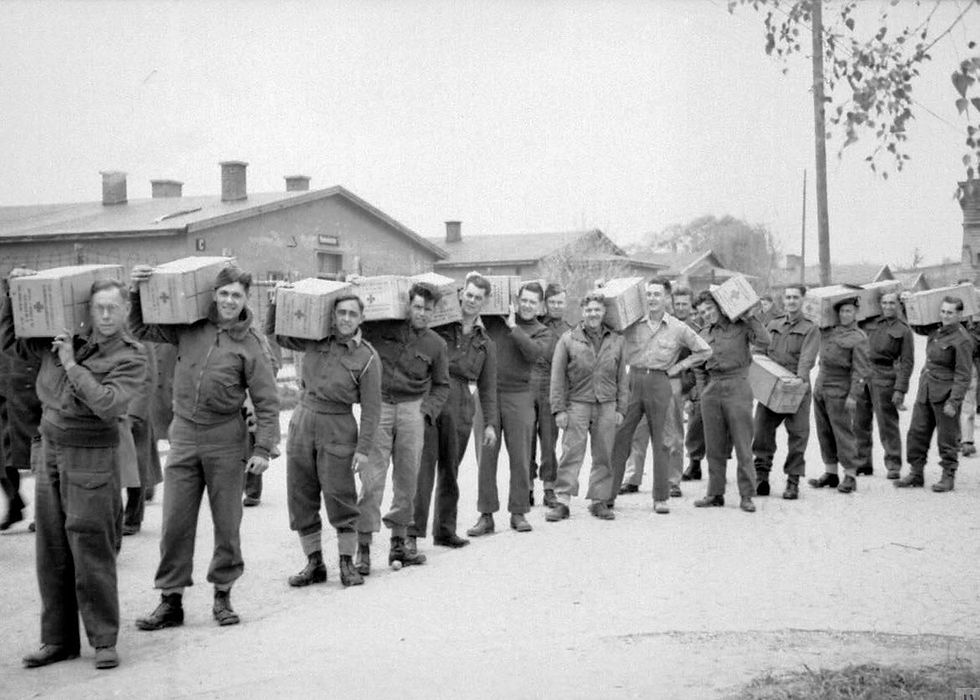
Prisoners in Stalag VII-A receiving their Red Cross parcels.

A local newspaper article from April 11, 1945, announcing that Valentine's family learned he was a prisoner of war.
Stalag VII-A
As the months went on, Valentine remained hopeful that liberation would soon arrive. As more and more fleets of American bombers soared overhead uncontested, it seemed that victory was near. Further confirmation of Germany’s desperation came throughout March and April as tens of thousands of new prisoners were brought into Stalag VII-A from camps all across the Reich. As the Russians and Americans pushed deeper into German territory, the German government hoped to move its prisoners deeper inland to use as possible hostages. For Valentine, the practical result was a camp completely overcrowded with prisoners from all Allied nations. It became absolutely filthy, full of lice, bed bugs, rats, and completely unsanitary living conditions. Food became scarcer and shelter was an absolute luxury. Many men were forced to resort to living under makeshift tents in the yard or sleeping in concrete culverts scattered across the camp. In a camp made for 14,000, it now housed over 80,000. The final weeks of the war were spent in misery.
Liberation finally came on April 29, 1945. After nearly five months of imprisonment, soldiers and tanks of the 14th Armored Division rolled up and through the gates of Stalag VII-A. The German guards were now prisoners of their former captives, and an American flag, handmade by a prisoner, was flown proudly over the camp. Valentine, like many other prisoners, was suffering from malnutrition and disease, however, meaning their celebrations were short lived. Within days they were sent to a nearby airfield where they were evacuated to camps across France for repatriation and rehabilitation. Valentine likely cared very little, however. For him, it was finally time to go home.

The liberation of Stalag VII-A

American POWs in Stalag VII-A, living in tents after the barracks were overcrowded.

Prisoners at Stalag VII-A eating outside due to the filthy conditions inside of the barracks.
The liberation of Stalag VII-A
The liberation of Stalag VII-A depicted in Apple TV's "Masters of the Air"
Since liberated POWs were given priority to travel back to the United States, Valentine was placed aboard one of the first transports leaving the European Theater. He arrived on June 4, 1945, and immediately called his family to let them know that he would be there soon. Like most prisoners, he was given two months of leave to reconnect with his loved ones and recuperate from captivity. It was a time of great mourning and celebration for the Valentines, however, as they rejoiced in the homecoming of one son, but felt the missing presence of the other they lost.
Although Valentine had to go back to duty at the end of the summer, he was mostly tasked with menial stateside positions until he was able to receive his formal discharge from the Army in December of 1945. He moved back to St. Mary’s and reinstated his old position at Stackpole Carbon, restarting what went on to become a forty-two year career with the company. Although the greatest adventure of his life was over, he still had plenty of excitement in his small hometown, surviving a flood which destroyed his home in 1955 and discovering a love of photography that kept him engaged throughout the rest of his life. He eventually found the love of his life, Mary, whom he married in 1967. Although the couple never had children, they found joy in their Church community and extended families which continued after his retirement in 1982. Richard passed away on September 7, 2011, and was followed by his wife, who joined him less than a month later.

A local newspaper article announcing his return home.

Valentine's final resting place.
A local newspaper article announcing his return home.