_edited.png)
The 36th Division Archive
_edited.jpg)
Major Lavern L. Hodges
Platoon Leader, Company Commander
D Company, 100th Battalion, 442nd Regimental Combat Team


Lavern Lee Hodges was born in Erick, Oklahoma, in 1907 as the only son of two southerners seeking new lives out west. Shortly after his birth, the family went to Niobora County, Wyoming, where his father tried, and ultimately failed, his hand at farming. Moving back to Cordell, Oklahoma, the family struggled to farm amidst the great “dust bowl” while Hodges went through the local school system. Eventually, his father gave up on farming and began working as a bookkeeper for a grocery store in Cordell which turned into a rather profitable career.


After graduation, Hodges joined his father in the service industry by working as a clerk in a drug store. By 1931, he had met his lifelong love, a nurse named Juanita, whom he married and settled down with in Cordell. In 1934, Hodges and his father moved to Elk City, Oklahoma, where they both went into business with the Snell Grocery Company. Together, they opened and managed the United Super Market in Elk City, which quickly became one of the most popular businesses in town and across the region. His success managing the company provided a comfortable living for the family as the shadow of war loomed on the horizon.
Despite his growing success in the grocery business, Hodges felt called to serve as he watched global conflict threaten to unravel the world around him. On January 8, 1941, Hodges became one of three men who voluntarily enlisted in the U.S. Army under the selective services law. He went through basic training and was assigned to G Company, 179th Infantry Regiment, 45th Infantry Division as a member of the Oklahoma National Guard. In October of 1941, shortly after the 45th Division took part in the Louisiana Maneuvers and was federalized, he was put into the enlisted reserves, due to his age of 28, and was permitted to come back home for a period of time. Unfortunately, the Japoanese attack on Pearl Harbor made short work of his time in the Reserves. With the United States at war, he was called to step up once again. Hodges was called back to active duty on January 9, 1942, and shortly thereafter received a commission to serve as an officer.
Hodges, promoted to Sergeant, was sent back to the 45th Division where he remained on active duty until leaving for officer's training school at Fort Benning in June of 1942, graduating that October as a Second Lieutenant. His first post was to help train other soldiers at the Infantry Training Center at Camp Wolters, Texas, where he ended up spendng the next two years of the war. It was not until January of 1944 that he returned to an infantry unit. Now a Captain, he traveled to Camp Gruber, Oklahoma, where he took command of M Company of the 222nd Infantry Regiment, 42nd Infantry Division. Unlike regular infantry companies, M Company was a a heavy weapons company, which in an infantry battalion was composed of heavy machine gun and 81mm mortar platoons. The company broke apart in combat, with different platoons supporting different rifle companies of the battalion wherever they were needed. As such, a more fluid leadership style was needed. He managed to do well in the role and in August 1944 was selected to travel overseas with the 1st Replacement Regiment out of Fort Meade

45th Division men on maneuvers in 1941.

An October 1941 newspaper article about Hodges' military service.
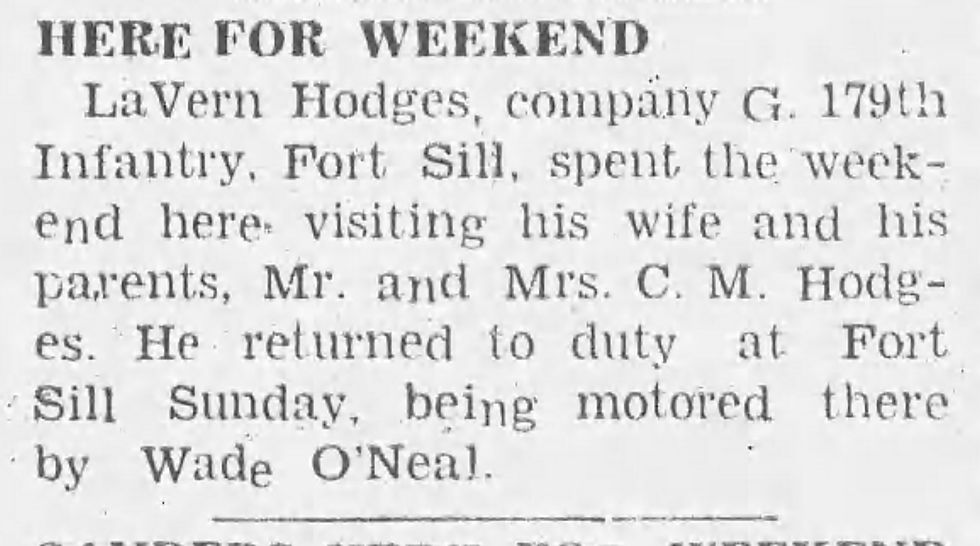
A February 1941 newspaper article about Hodges' military service.
45th Division men on maneuvers in 1941.
After a long voyage to Europe, Hodges ended up in the 84th Replacement Battalion out of Sarthe, France, where he was put into a pool of officers waiting for their combat assignments. Likely rather nervous after years of stateside training, his wait came to an end in late October when he was sent down to the mountains of the Vosges Forest in a group of twenty-three fresh-faced officers. Upon their arrival they discovered their assignment to a rather unique combat unit: the 442nd Regimental Combat Team.
The 442nd was composed almost entirely of Japanese-Americans from Hawaii and the Western United States. While the Hawaiians were mostly early volunteers, nearly all of the mainlanders had either been incarcerated or had their families incarcerated by President Roosevelt’s infamous Executive Order 9066. Despite being born and raised Americans, these second-generation Japanese Americans, Nisei, were forced into prison camps across the United States after being deemed untrustworthy “enemy aliens” by the U.S. government following Pearl Harbor.
After an experimental Army infantry unit composed of Hawaiian Nisei, the 100th Infantry Battalion, achieved great victories in the Italian theater, two more battalions and support units were raised from the remaining Nisei of Hawaii and the mainland camps. Once they traveled overseas and joined with the 100th Battalion in Italy in 1944, the 442nd Regimental Combat Team was born. By the time Hodges arrived to the 442nd, it contained a mix of enlisted and drafted men from the camps and Hawaii, but all shared the common goal of fighting for their nation in hopes that it might show they were not disloyal, but true red-blooded American citizens.

Men of the 442nd in the Vosges shortly before Hodges joined the unit.
Men of the 442nd in the Vosges shortly before Hodges joined the unit.
Hodges, despite his rank of Captain, joined D Company of the 100th Battalion as a platoon leader on November 4, 1944. As he quickly found out, the entirety of the 442nd had been decimated only days before during its most ferocious combat yet. Attached to the 36th Infantry Division in the Vosges Mountains, a region of neverending steep forested hills in central France, it had been tasked with rescuing a cut-off battalion of the 36th Division which was at risk of total capture near the town of La Houssiere. Rather than shirk at the responsibility and risk of the mission, the Nisei of the 442nd fought valiantly for nearly a week through the dense trees of the Vosges trying to break through the German lines to rescue the survivors. By October 30, 1944, the 442nd reached the battalion and saved nearly 275 men. The victory came at a great cost, however, with the regiment suffering hundreds of casualties. Hodges was brought in to replace one of the platoon leaders lost in D Company.
When Hodges joined five days after the rescue, he found the unit in a rather sorry state. D Company served as the heavy weapons company for the 100th Battalion. Despite their important role maintaining the battalion's heavy weapon teams, D Company could muster a mere 57 men to operate its machine guns and mortars. The 100th Battalion as a whole boasted a little over 250. Hodges group of officers were the first replacements in the 442nd since the rescue of the lost battalion. Although they were needed desperately, they also had fairly few men left to command.
The 36th Division had put the 442nd into defensive positions on the hills where they rescued the lost battalion, tasking the 100th with keeping road blocks on the road east and west through La Houssiere and holding the hill mass observing the Corcieux Valley to the south. The weather was poor, rainy, and cold as the weary men put together the best defenses they could, digging trenches into the muddy ground. Enemy artillery steadily peppered the entire regimental line as American and German patrols clashed trying to uncover more about the strength of their opponents.
The first three days of Hodges’ time with the company were largely spent undergoing enemy fire, improving defensive positions, and trying to ingratiate himself among the men. Spread out among the other companies of the 100th, some of the company’s troops helped to fend off scattered German patrols but for the most part things were muddy and miserable. On November 8, the first snowfall of the season hit their foxholes. It was a somewhat welcome relief from the rainy and sleepless nights most of the regiment had experienced over the previous week. Most of Hodges’ day was spent, however, helping the men of D Company pack up their gear to withdraw. The 142nd Infantry Regiment had come to relieve the 100th Battalion after breakfast, allowing the battalion to withdraw to Bruyeres where the men were able to shower and get fresh clothes.

A heavy machine gun team of the 442nd in the Vosges

Hodges assigned to D Company

One of the 442nd's heavy mortar teams in the Vosges
A heavy machine gun team of the 442nd in the Vosges
On November 9, the company trucked down to Baines Les Baines where a 36th Division rest camp took in the weary Nisei for several days of much-needed rest, providing movies, mineral baths, church services, and plenty of warm food while the Vosges snow piled up outside. The company was back on the move by the 11th, traveling south on ¾-ton weapon carriers in a miserable cold wind on poor rural roads. It was a rather dreary three-day journey through the entirety of Southern France before they reached Nice, along the French riviera. Here the 100th Battalion was to set up the regiment’s new positions along the Maritime Alps.
D Company marched up top the mountain town of Saint-Martine-Vesubie on November 15 where Hodges and the other platoon leaders immediately began scouting out possible defensive positions in the nearby mountains. The entire battalion went to work digging their line on the 17th, facing their first enemy fire only a day later as German artillery began hitting the mountaintops around them.
The Maritime Alps separated the French Riviera from Italy. After American forces had liberated that region of France during Operation Dragoon in August of 1944, the German military began fortifying the mountains with detachments of troops in Northern Italy. Although little major fighting occurred, sporadic skirmishes and artillery duels were the norm in the Alps. The rest of the 442nd Regiment arrived days after the 100th Battalion settled into the mountains, taking their spot in the rather scattered line of troops separating the Germans and surviving Fascist Italian forces from a now liberated France.

The Maritime Alps, taken by a D Company member

A squad of D Company in a rest area near St. Etienne, Maritime Alps, November 1944
The Maritime Alps, taken by a D Company member
Hodges’ mortar teams were able to get some rounds on enemy targets during their first week and a half in the Alps before the battalion was forced to move again, traveling to the coastal town of Menton on the morning of November 26. It was a rainy, cloudy, and cold day which made mountain traversal fairly hazardous. Despite the weather, they began replacing troops from the First Special Service Force in the mountains ranging from Menton all the way to Castillon. The line was only a matter of kilometers from the Italian border and subject to regular attacks by the German 34th Infanterie Division. During this fairly stagnant period, the 442nd rebuilt its strength as groups of replacements from the United States slowly filtered into the line companies. This helped with the defenses since the vast distance required fighting positions to be built far apart. The many back and forth patrols, which often spawned sporadic small arms engagements, proved a good way of teaching these men the basics of combat in a fairly low-stakes environment.
On December 9, 1944, Hodges, who had become a respected platoon leader during his first month of leadership, was appointed the commanding officer of D Company by his battalion commander. Although he had only been in the 442nd for a little over a month, he considered it a high honor. In a letter he wrote back to his wife about the promotion, he bragged that his men were a “loyal and courageous group of fighters, fearless and determined.” As company commander, he was now in charge of deploying and organizing all of the platoons and weapon teams of the company, including their mortar and machine gun positions scattered across their stretch of the alps. By December 19, D Company was back to 127 men in strength and engaging in regular combat with German patrols, supporting rifle positions with heavy fire as the Germans tried to make their way through the mountains. Traversing the snowy and ice-ridden mountaintops was hazardous enough, but the strategic deployment of Hodges’ heavy guns made it nearly impossible for their German opponents.
As 1945 opened, the month of January was spent in continued scattered combat against probing German forces. Many days consisted of artillery duels with D Company’s 81mm mortars doing most of the work. Infantry patrols worked to find specific targets, from enemy mule trains to gun positions to patrols, which allowed D Company’s mortars to do what they did best: shell them. January 15 found the 100th in an extended firefight after several patrols towards the village of Olivetta engaged countering German patrols, spawning a battle among the cragged cliffs and rock faces of the mountains. In these cases, the 81mm mortars of D Company proved exceptionally helpful for providing support around odd angles and crevices. Although not the most mobile action, Hodges was quite pleased with the performance of the Nisei under his command. In a letter home he expressed how proud he was of the company “for they really are one fighting bunch as good as any in the Army.” He boasted of the name they had made for themselves and assured that he would do his best to “stand up to their record.” Even though there was “a little fighting to do,” his men remained in high spirits and performed admirably. Hodges quickly adopted the social mission of his men, telling his wife how “they are Americans and dislike the connection of the Japanese in their designation.” They were truly brave patriots, he recalled, to whom all Americans owed a “debt of gratitude.”

One of D Company's mortar teams in the Maritime Alps

One of Hodges' mortar positions in the Alps

A January 1945 article about one of Hodges' letters home.
One of D Company's mortar teams in the Maritime Alps
Combat in the mountains was not entirely impersonal and there were moments where the distance between combatants closed in a rather personal way. In one letter home to his wife, Hodges wrote that he came upon a group of French men and women tied to a wall by German soldiers, left to starve. Other patrols in Hodges’ battalion came across frozen bodies of dead German and Italian troops, victims of their indirect fire. At one point Hodges found the body of a dead German captain from one of the Luftwaffe field units operating in the region. As a reminder of his experiences, he removed a set of aviator wings from the man’s uniform and shipped them home to his wife.
While the men of the 442nd did not have any special badges to decorate their uniforms, on February 6, 1945, they received their very first batch of unique shoulder sleeve insignia. Although approved over a year earlier, the hexagonal patches were not finished and shipped overseas until the winter of 1945. Each man received three patches for his field jacket and service shirts, allowing Hodges and his troops to finally brandish the torch of liberty on their uniforms.
February and March allowed the 442nd, and the 100th Battalion, to maintain its fighting reputation by pursuing more aggressive combat operations against Germans in the Maritime Alps. On February 7, Hodges’ company was called to provide heavy support in the towns of Mortola and Grimaldi, coastal cliff-side cities just across the Italian border. As infantry attacked near the towns, the mortars played an important role knocking out enemy dugouts and gun positions to keep the Germans from reacting with their full potential. Countless night patrols by the various companies of the 100th in this period required D Company’s heavy guns to provide supporting fire, whether it was to suppress enemy troops or provide cover for Nisei on the retreat. Hodges’ guns were essential in maintaining a regular schedule of intelligence gathering and combat patrols.

One of Hodges' men wearing a winter parka besides one of their mortars in the Alps.

A mortar squad under Hodges' command in Menton, France

One of Hodges' men next to a mountain mortar position
One of Hodges' men wearing a winter parka besides one of their mortars in the Alps.
On March 15, 1945, the 100th Battalion was relieved by French troops and sent to Marseilles for new overseas movement. Turning in their heavy weapons and vehicles, the troops boarded LSTs and set off for Italy. Arriving in Livorno on March 25, the return to Italy was a homecoming for some of the 442nd’s veterans. For replacements like Hodges and most of his company, however, it was a new theater of war with its own unique challenges. By the end of the month, the regiment was attached to the 92nd Infantry Division, composed of segregated African-American troops, and sent northward to join American forces pushing against the German Gothic Line.
When D Company entered the line, it held the distinction of being one of the only companies with all-Nisei officers, barring its company commander of course. While the 442nd originally required all officers to be white, over the course of combat many Nisei were permitted to receive field commissions and serve as officers. In April of 1945, Hodges was the last caucasian serving in D Company. All of his other officers and enlisted men were Nisei. As seen in his letters, Hodges was proud of the accomplishments of his men and bore this unique honor as a point of pride.
The 100th Battalion entered combat once again on April 5, jumping off after a midnight march to attack a series of mountains near the town of Vallecchia as part of diversion for other American assaults on the Gothic Line. The 100th’s specific targets were four hills being used as fortress-like observation posts known as Georgia and Ohio 1, 2, and 3. After a massed artillery barrage, the battalion launched a frontal assault against Georgia, fighting fiercely against German soldiers embedded in the rocks and log bunkers. In a testament to its combat prowess, the battalion managed to seize the crest of the hill within thirty minutes. Hodges’ mortars played a particularly important role that day helping to target key German positions and fend off German counterattacks trying to retake the hill. The 100th continued its assault the next morning, assaulting pillboxes and gun positions through the Ohio hills against stiff German resistance. Despite foggy weather and rain, and a lot of staunch German defenders, the hills were taken by the afternoon.

100th troops after taking hills Ohio 1, 2, and 3

442nd men marching through the Po Valley in April 1945

Florida and Georgia Hills taken by the 100th Battalion
100th troops after taking hills Ohio 1, 2, and 3
The regimental assault took a different shape when it renewed on April 10, as German forces retreated to defensive positions above the city of Carrara. The 100th began an eight-mile march into the mountains on the 11th with Hodges ordering his men to pack their heavy weapons on mules for the long trek. After many hours, they reached the town of Colonnata and seized it without resistance. The 100th was ordered to hold the town as they had advanced well past their supply lines. Over the next three days the men hunkered from continuous German artillery barrages while waiting for the go-ahead to keep up the advance.
On April 15, the 100th moved out towards Carrara, subjecting itself to artillery barrages throughout the day as it moved to an assembly area at Gragnaan. Two of its line companies, B and C, with some D Company men in tow, began assaults on veritable mountain fortresses named Monte Pizzaculo and Fort Bastione, silencing key points of German resistance in the area over the next two days.
Throughout the following week, the entire regiment continued an all-out drive against German forces through numerous Italian cities and towns, with Hodges’ D Company playing its part to support the 100th’s advance with heavy weapons fire. The Germans slowly fell into an all-out retreat as hill after hill and town after town were taken by the veteran Nisei troops. By April 25, the 100th hopped onto any vehicle they could find to chase the Germans up the coastline of then Ligurian Sea, past Genoa and all the way to the Po River. German resistance began to collapse all around them. The big news came on May 2, 1945, that all German forces in Italy had surrendered to the Allies.
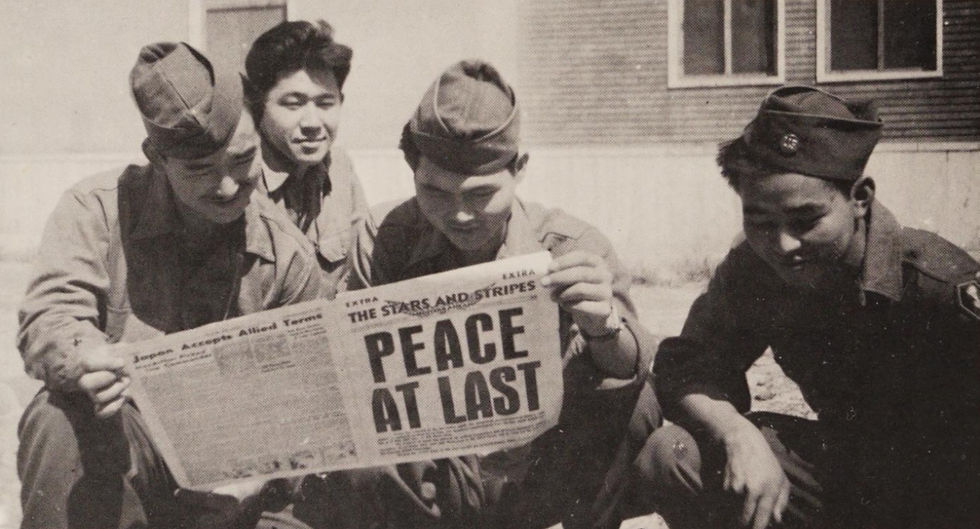
Peace!

100th Battalion troops marching through Alessandra, Italy

crossing pontoon briges in pursuit of the German Army
Peace!
After many months of tough combat, Hodges and his crack heavy-weapons Nisei had finally defeated their German foes. It was less than a week later that word came of the complete German surrender up north, signaling the conclusion of the war in Europe. For the 442nd, however, their job was far from done.
On May 17, the entire regiment was brought to Ghedi Airport, near Brescia, in the northernmost region of Italy where they set up a massive tent city to begin their new occupational task: processing the hundreds of thousands of German prisoners of war. D Company did its part in this task over the next month, disarming German soldiers, documenting and processing their capture, and facilitating the organization of prisoners into manageable groups. One of Hodges’ friends from Oklahoma met up with him during his time at Ghedi, telling a newspaper back home how Hodges was surrounded by thousands of Germans and their equipment while helping to run the POW enclosures. He described Hodges as “brown as a berry,” without his old “tummy,” and with hair a little more gray than he remembered seeing at the grocery store so many years before. Hodges was now a veteran from one of the European Theater’s most distinguished combat units.
The 442nd continued performing a number of occupational duties, such as guarding prisoners and policing, throughout the summer and fall of 1945. Sometime around October or November, Hodges was asked to leave his beloved D Company to become the executive officer of the 100th Battalion, its second in command. It was a privilege he took in stride as he continued his leadership of the 442nd into the new year. He was eventually promoted to Major in April of 1946 but it was not until June that he, along with the rest of the 442nd, were finally permitted to return to the United States. Landing in New York, he finally split from the 442nd as he traveled to Fort Sam Houston, Texas, where he was finally discharged from the United States Army later that summer.

D Company on parade in 1945

One of D Company's jeeps at Ghedi Airfield

D Company on parade in 1945
A well-respected and decorated officer from one of America’s most distinguished combat units, Hodges returned home to Elk City as a hero, but ready to get back into civilian life. By the spring of 1947 he was hailed as one of Elk City’s most prominent businessmen, serving as the vice president of the local chamber of commerce after opening his own supermarket. That grocery, named Hodges Supermarket, he claimed started as an idea during his time overseas which he had hoped to make possible upon his return home. It quickly became one of the most popular in Oklahoma and was praised for being “modern in every possible way,” featuring a snack bar, powder room, lots of parking, high-end refrigeration equipment, and many more amenities for his customers. He was back in business after five years at war.
His military service with his Nisei brothers-in-arms was still very important to Hodges, however, and he quickly joined the newly formed Japanese American Veterans Association as well as the Veterans of Foreign Wars, American Legion, and 442nd Regiment Association. After a few years at home he also went back into the U.S. Army reserves, making lieutenant colonel by 1954. Regardless of where he was throughout the rest of his life, he always spoke highly of his old Nisei comrades, advocating for their advancement and recognition in American society.
In 1956, Hodges opened up a nursing home in Elk City with his wife, whose passion was to care for the elderly and infirm. In 1959, after ten years of exceptional business, he sold his grocery store to focus all of his efforts on the nursing home, improving the lives of the elderly across Southwestern Oklahoma. He could not stay out of the food industry forever, however, and in 1961 founded the White Lotus Food Company, which became known for processing beef and vegetable turnover. He was an active citizen of Elk City, working with the Boy Scouts, his local Mason Temple, and the Rotary Club while holding the title of Chairman of a Housing Authority, vice-president of the Western Oklahoma Historical Society, Representative of Elk City’s Third Ward, deputy director of their Civil Defense agency, and director of a day care which he founded.
Although Hodges and his wife never had kids before he passed in 1979, he left behind a military and civilian legacy that reflects proudly on the nation and communities he chose to serve.

Hodges being promoted to Lieutenant Colonel in 1954.

Hodges, on left, presiding over the White Lotus Food Company

Hodges in the local Rotary Club
Hodges being promoted to Lieutenant Colonel in 1954.