_edited.png)
The 36th Division Archive

Lieutenant John J. Howard
Executive Officer
I Company, 357th Infantry Regiment, 90th Infantry Division


John Jackson Howard was born on December 2, 1916 in the then-booming riverfront industrial town of Ashland, Kentucky. The youngest of four, he was raised in a household supported by his father, a brakeman for the Chesapeake & Ohio Railroad Company at its yard in neighboring Greenup County. Like his siblings, John attended Ashland High School and played on the football team. His short, stocky build–paired with red hair and bright blue eyes–made him stand out among his peers.


John's University of Kentucky ROTC Uniform

An overnight bag used by John in the Army
Although John’s dad only made roughly $45,000 in today’s currency, all three sons in the Howard family were able to attend college. When time came for John to choose a school, he settled on the University of Kentucky in the heart of Lexington, Kentucky. As the state’s flagship university, John had a wide breadth of potential paths before him. Starting during the spring of 1936, he went into the school’s College of Engineering for his degree path. His special focus throughout college was metallurgical engineering, a discipline closely tied to the coal and industrial sectors of his eastern Kentucky home.
John was not content with just his studies, however, but decided to further his personal discipline and fortitude by joining the university’s Reserve Officer Training Corps (ROTC) program. The program consisted of around a hundred cadets from all walks of life. John was selected as among the corps’ best candidates, however, and put into C Company, 1st Battalion, which was the university’s company of the Pershing Rifles. The Pershing Rifles, the honors fraternity for the military program at UK, selected cadets of strong academic standing and proven character for additional training and instruction. Among John’s fellow cadets in C Company was William T. Young–later known for founding Jif Peanut Butter and a business empire. After wearing the white “K” on his shoulder alongside John, Young went on to serve before becoming a noted philanthropist and community leader within Lexington and Kentucky.

A 1938 photo of UK's C Company of the ROTC Battalion. John is standing farthest on the left.

John in the ROTC uniform shown above.

John on the left with his older brother Herman on right
A 1938 photo of UK's C Company of the ROTC Battalion. John is standing farthest on the left.
Throughout 1937, John delved deeper into campus life by taking on additional responsibilities as a sergeant in ROTC. He also became part of the drill team for his company. Using 1903 Springfield rifles, the cadets trained for hours in aesthetic and precise movements slinging and tossing their rifles. One of the largest events for the corps was the annual drill competition, bringing together all of the cadets in fierce competition. In the 1937 match, John was part of the winning team, keeping up C Company’s four-year victory streak. He was awarded a badge for his victory, which he displayed prominently on his uniform.
In 1938 John began focusing more intently on his chosen career path and grew uncertain of a long-term military career. He joined the Norwood Mining and Metallurgical Society, a club for fellow engineering students seeking to enter into that field, as well as Triangle, an engineering fraternity at UK. Despite his promotion in ROTC to second lieutenant in October of that year, John likely left the organization prior to the start of the new year to focus on his professional studies. Although he left the program, he remained fond of his time with the corps and preserved his uniform as a keepsake.

Howard's ROTC uniform back in front of Memorial Hall, where he took photos wearing it with ROTC.

Howard's ROTC uniform back in front of Memorial Hall, where he took photos wearing it with ROTC.

Howard's entry in the 1940 UK Yearbook, "The Kentuckian"
Howard's ROTC uniform back in front of Memorial Hall, where he took photos wearing it with ROTC.
John finished his last two years, graduating in 1940 from the College of Engineering with his bachelor’s of science in metallurgical engineering. Shortly thereafter, he returned home to Ashland. He moved back in with his parents and secured work alongside his father at the Chesapeake and Ohio Railroad while the dark clouds of war formed in the horizon.
On December 7, 1941, the Japanese Empire attacked the United States at Pearl Harbor. Though focused on his civilian work, John’s sense of duty–instilled while serving in ROTC at UK–likely encouraged his decision to join the United States Army a month later, officially entering service on January 28, 1942. His oldest brother, Herbert, working as a school principal in Boyd County, followed suit but in the United States Navy. As a college ROTC graduate, John received a commission as a second lieutenant and underwent abbreviated officer training. By the end of the year he was assigned to his long-term combat unit, the 90th Infantry Division, and was promoted to first lieutenant.
Formed from National Guard units in Oklahoma and Texas, the “Tough Hombres” of the 90th Division were federalized in 1942 out of Camp Barkeley, Texas. It was here that John joined the division as the executive officer of I Company, 357th Infantry Regiment. As executive officer, he was responsible for a vast amount of tasks needed to maintain the company including training, supply, discipline, administration, and executing all commands of the company commander, who was in this case, Captain Richard C. “Buck” Shaw. John played a vital role in preparing I Company for future combat operations as the division traveled from Camp Barkeley to Camp Bowie, Camp Granite, Fort Dix, and numerous maneuvers and field scenarios. A member of I Company’s 3rd Platoon, Private Ernest R. White, described John as a soft-spoken leader who didn’t say much, but never talked down or spoke harshly to the men.

A photo of I Company, 357th Infantry Regiment at Fort Dix. John is the short officer in the middle.
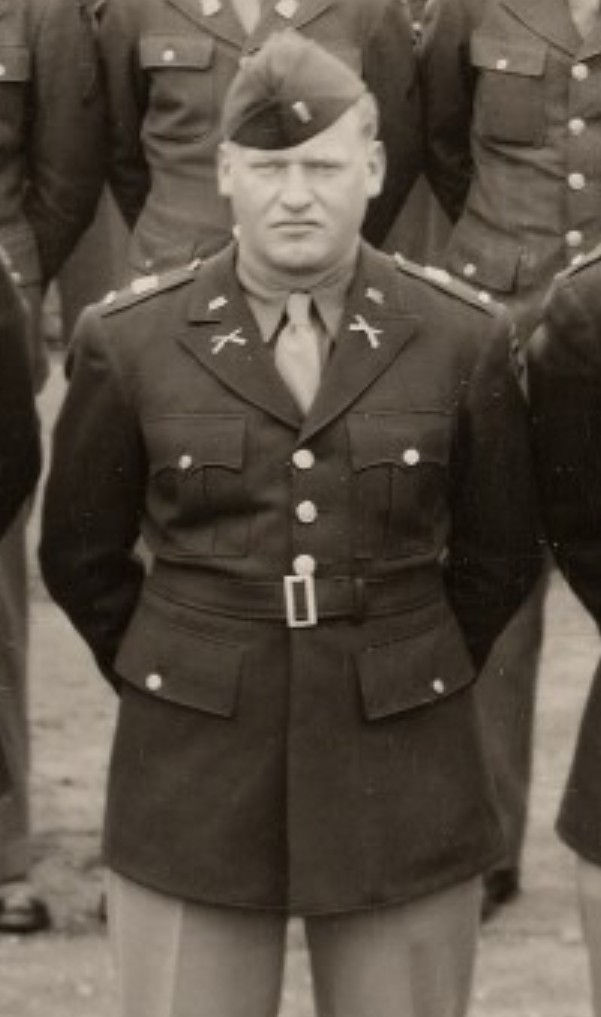
John in the company photo.

John during training stateside.
A photo of I Company, 357th Infantry Regiment at Fort Dix. John is the short officer in the middle.
On March 23, 1944, John sailed out of New York with the rest of the 90th Division on a course towards Europe. Aboard the H.M.T. Dominion Monarch, an ex-British cruise liner converted for troop transport, he arrived at Liverpool Harbor on April 4 as the first batch of 90th troops in Europe. The division was sent to Camp Kinlett Park in Shropshire, England where it picked up a daily training regimen and saw visits from noted commanders such as Patton, Bradley, and Middleton. On May 14 the division moved to Race Course Camp in Wales where they remained eager and on edge for the inevitable invasion of France.
The 90th Division was tasked to be one of the first American divisions to land during the invasion. With a detached unit landing with the 4th Division on D-Day itself, the rest of the 90th was slated to land on Utah Beach between June 7-8 where they would support the initial breakout efforts by driving northward up the Normandy coastline before turning towards the key objective of Cherbourg. On June 4, 1944, John and the 3rd Battalion of the 357th Infantry Regiment marched to the train station at Chepstow which took them to Cardiff to embark aboard the SS Bienville for the final channel crossing. The following day the convoy assembled in the Bristol Channel while John was briefed on the mission alongside other platoon leaders and NCOs. The final channel crossing began in pitch black at 0200 on June 6, 1944. At 0930, the Bienville anchored off of the Normandy coast while artillery blasted the beachhead and troops of the 4th and 101st Divisions made their way ashore.
At 0830 on June 8, John crawled down the cargo nets of the transport into the LCVP waiting below. He took command of the boat carrying thirty-six men of I Company’s 3rd Platoon. They circled around the water for some time until making the final trek to the beach around 1400. Private White recalled that John spoke to the men onboard at the time, saying
Well, men this is the nitty gritty. We’re all together now, but we won’t all come back together.
The somber words fell on anxious but eager ears. White never saw John again after that boat ride. Around 1530, all men were on the shore and I Company began marching to the transit area near Loutres, an estate roughly five miles inland, where Germans were fighting only a thousand yards beyond. Donned in their gas-impregnated HBT uniforms, the battalion executive officer, Charles E. Ronan, recalled the impregnation caused them to almost look German in color.

90th Division troops moving inland from Utah Beach
90th Division troops moving inland from Utah Beach
On the morning of June 9, the mission of the 90th Division was changed. Rather than march up the coast, they would pass through the 325th Glider Infantry Regiment of the 82nd Airborne Division just east of St. Mere Eglise along the La Fiere Causeway. The 82nd, fighting for several days and now held up by fierce German opposition, was to be relieved by the 90th who would take several river crossings along the Douve River. John’s 3rd Battalion was ready to move by 2300, as machine gun tracers and flak bursts dotted the night sky like an array of stars.
At 0030, 3rd Battalion led the 357th Regiment from its assembly area, marching through the ruins of St. Mere Eglise and lines of American artillery. Problems quickly began to arise, however, as all of the regiment’s maps were meant for the original planned attack up the coast. New maps were distributed, but they were of different scales and focus areas, making it impossible to uniformly issue movement. Furthermore, the infamous hedgerows, first discounted as a minor obstacle, proved larger, more overgrown, and neverending among the Normandy fields. The hedgerows made it extremely difficult to traverse the terrain and to maintain contact with friendly forces, leading L Company to get lost in the march. John and the rest of I Company took the lead in L Company’s stead, taking the 3rd Battalion onward, through the 82nd Airborne lines, and towards the sounds of combat.
The 3rd Battalion, holding the northern (furthest right) position of the regiment, was tasked with taking the village of Amfreville along one of the main roads in the area. Setting off around 0900, resistance was fairly light for the first few hours with scattered German troops causing most of the concern. They reached Amfreville around 1200 and found the town mostly empty, with the bodies of German soldiers and American paratroopers setting a rather grim scene as the wreckage of war filled its streets. The area was held by the German 1057th Infanterie Regiment of the 91st Infanterie Division, a fairly typical infantry division of the German Army. Nevertheless, they knew the terrain of Normandy from their occupation and were prepared to use it to their advantage.

Hedgerow Fighting

An idea of the terrain John and his men were up against, the thick hedgerows of the Cotentin Peninsula.
Hedgerow Fighting
I Company continued moving forward up the main road towards Gourbesville when, after thirty or forty minutes, the German defenses erupted with intense fire. The 1057th had dug in heavily along the hedgerows just east of Gourbesville, putting up a stiff resistance with automatic weapons, mortars, artillery, and snipers. 3rd Battalion was quickly thrown into chaos as the men attempted to hastily form a firing line to begin opposing the entrenched defenders. Sometime during the first hour or so of the fighting, however, tragedy struck.
As the battalion’s assault faltered amid the chaos, John and the rest of the I Company command worked desperately to reign in their platoons and press an attack. At one point John gathered with the company First Sergeant, Clyde Dowdy, and Captain Shaw to prepare new directions for the company when a German mortar round landed directly beside them. While the shrapnel threw all three men to the ground, severely injuring Dowdy and Shaw, John was not so fortunate. He was killed instantly on a Normandy roadside, only minutes into his first combat action.
I Company and the rest of the battalion were devastated by their baptism of fire. Howard, a steady and respected presence of the company, had been taken out mere minutes after they entered into action. Throughout the rest of the day I Company continued to press the German lines to no avail, suffering another two men wounded in action. Battalion surgeon Captain William McConahey recalled working at an aid station in Amfreville when men brought back began to shout
They’re shooting the hell out of us! Lieutenant Howard has been killed! The Heinies are counterattacking, and will soon retake the town!
A renewed assault took place that evening, but no progress was gained. By that night, seventeen men had been killed across the 90th Division during its first major combat operation. Lieutenant John J. Howard was one of the first.

Map of the 90th's initial attack on June 10, 1944. John's battalion noted on the far right flank of the 357th along the road.

The rough area of the road and terrain where John was killed. It was more overgrown during the time of combat.

John listed as KIA on the company morning reports.
Map of the 90th's initial attack on June 10, 1944. John's battalion noted on the far right flank of the 357th along the road.
Eventually, John’s body was brought back to St. Mere Eglise in the rear where he was processed and buried in the No. 1 Cemetery in the city set up by VII Corps. Taken from his body before burial were a few simple reminders of the life now gone: a Kentucky driver’s license, his C & O Railroad ID card, an immunization record, a lieutenant bar, a pen, a bracelet, a knife, 150 francs, and a cigarette lighter. He was put in Grave 159 between two 82nd Airborne paratroopers.
Back home, his family learned of his death within a few weeks. Devastated by the loss of his brother, John’s other older brother, Harlan, decided to enlist in the United States Navy. The family was left shattered and helpless. With the war ongoing, there was no way to bring John home. Instead, all they received were whatever items had been left in his footlocker, such as his dress uniform, raincoat, and overnight bag.
Not until 1947 did the government begin offering families the option of transporting the remains of their sons, husbands, brothers, and fathers back to the United States for burial at home. John’s family opted for this option and he was disinterred from St. Mere Eglise that December. By May of 1948 he had arrived back in Ashland, where the community held a ceremony honoring his memory and sacrifice at the John Steed Funeral Home. He was permanently laid to rest at Rose Hill Cemetery.

John's grave in Ashland.

John's burial at the St. Mere Eglise cemetery.

John's grave in Ashland.
John's grave in Ashland.
While John was one of the roughly 8,000 Kentuckians killed in action during WWII, he was one of only around 300 University of Kentucky alumni/students. He was one of UK’s three alumni killed during the Normandy landings and the second after an LCVP operator who hit a mine on June 6. He is among those listed in a special 1947 edition of the UK Alumni newsletter featuring the stories of all the university’s alums who were killed in action during the war. After the university constructed Memorial Coliseum in 1950, dedicated to all Kentuckians who died in WWI and WWII, his name was included on a displayed list of the dead and represented by one of 332 Gold Stars for those the university lost. In 2024, the university finished renovation of the coliseum and John’s name now resides on a pillar outside the entrance alongside the names of all other Kentuckians who perished in the war.
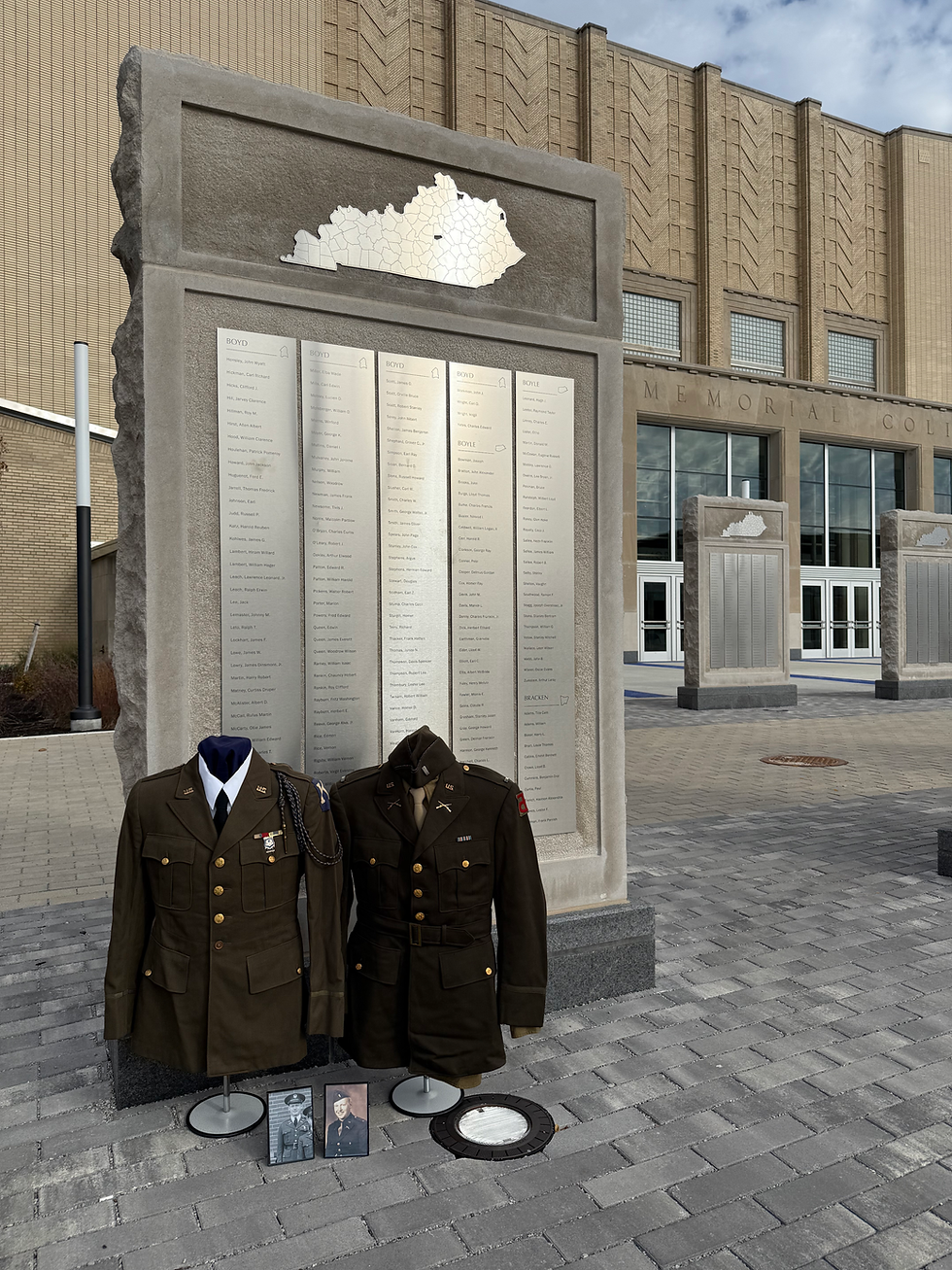
John's uniforms in front of the new Boyd County list of names at Memorial Coliseum at the University of Kentucky.

John's uniforms in front of the new Boyd County list of names at Memorial Coliseum at the University of Kentucky.

Howard's bio in the 1947 University of Kentucky Alumni newsletter describing all of the university's KIAs.
John's uniforms in front of the new Boyd County list of names at Memorial Coliseum at the University of Kentucky.