_edited.png)
The 36th Division Archive

Soldat Riechmann
4. Kompanie, I. Battaillon, Infanterie-Regiment Nr. 13,
26. Infanterie-Brigade, 13. Infanterie-Division


This Model 1916 stahlhelm was once worn by a Soldat Riechmann, who served in 4. Kompanie, I. Battaillon, Infanterie-Regiment Nr. 13, 26. Infanterie-Brigade, 13. Infanterie-Division. Based on the unit’s service history, replacement timeline, organization, and other features of the helmet, the owner likely joined as a replacement in the 13th Regiment during the summer of 1918 and fought throughout the fall before being captured, wounded, or leaving this helmet behind while fighting American forces in the Meuse-Argonne. While we do not know exactly when this was captured, being a bringback to the United States lines up with the regiment’s service history and provides a likely window for the end of this soldier’s military career. As such, this article focuses on the late-war engagements of Infanterie Regiment Herwath von Bittenfeld (1st Westphalien) Nr. 13 and the battlefields this helmet bore witness to.

Featuring its original "Buntfarbenanstrich" camouflage pattern added at the end of the summer of 1918.


Stamps reading "TJ 66," designating this helmet as produced in the C. Thiel & Sohne Factory in Lubeck, Germany. Thiel is a rarer making, only producing stahlhelms in sizes 66 and 68.
Featuring its original "Buntfarbenanstrich" camouflage pattern added at the end of the summer of 1918.
Founded during the Napoleonic Wars and based out of Munster, Lower Saxony, the 13th Infantry Regiment spent the first 100 years of its service as a mainstay of the Prussian military tradition, seeing the growth, unification, and expansion of the German Empire while the men of its ranks came and went. In August of 1914, the regiment was called up two days before the German invasion of Belgium, the kickstart of the war on the Western Front. The regiment participated in early battles around Liege, St. Quentin, the Marne, Reims, and Arras before settling into the initial trench warfare of WWI at Artois and Flanders. Like many German regiments, it was organized into three battalions each composed of four kompanies. The I Battalion, which this helmet was eventually a part, was composed of the 1st, 2nd, 3rd, and 4th Kompanies, as well as attached machine gunners. The 13th Regiment fell under the command of the 13th Infantry Division, alongside the 15th, 55th, and 158th Infantry Regiments (the 158th would be removed in 1916).
The regiment spent the next three years all around the Western Front, fighting off British, Australian, and French forces in engagements ranging from Neuve Chapelle, Verdun, the First Battle of the Somme, Operation Westphalia, Operation Blucher, Aisne, and Chavignon. As an early-fighting regiment engaged in such heavy operations, however, the 13th took thousands of casualties throughout the war, requiring it to be rebuilt numerous times in its combat career. While replacements were initially sourced from the regiment’s home region around Munster, the drastic need for replacements led to regular transfers and replacements from units and regions across Germany. By 1917, this was the norm. The 13th and its parent unit, the 13th Infantry Division, were recognized numerous times by the German high command for its heroism and success on the Western Front.
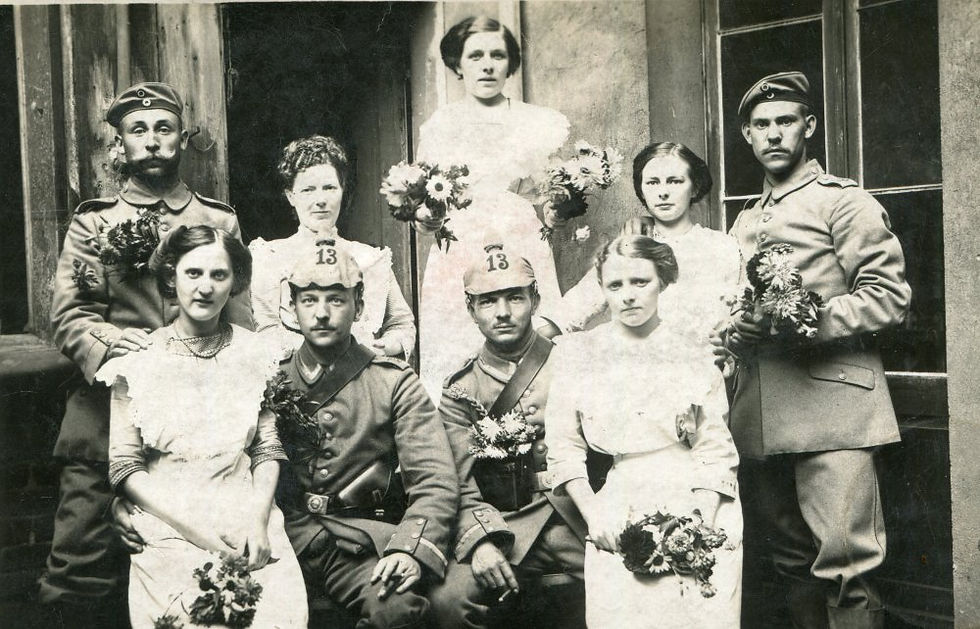
Infantrymen of the 13th Infantry Regiment before heading off to war in 1914

Infantrymen of the 13th Infantry Regiment in field uniforms preparing to march back to the front in 1915.

An Infantryman of the 13th Regiment in 1914.
Infantrymen of the 13th Infantry Regiment before heading off to war in 1914
In 1918 the regiment was once again put through the wringer fighting at Picardy, the Somme, and Ancre. By April of 1918, the 13th Infantry Division was at roughly 40% of its combat strength, requiring a mass influx of men in May and June before going back into the line at the start of July.
The 13th Regiment, newly rested and full of replacements, was not destined to stay in such ample shape, however. Put into the line near Hamel, in the Somme, the regiment was tasked with holding a sector near Vaire Wood after replacing some worn and weary troops. Only days after they reached their positions, on July 4, 1918, the entire 13th Division was subject to a devastating assault that became known as the Battle of Hamel. Over the course of ninety-three minutes, the entire 13th Division line was broken by a massed combined-arms assault of Australian and attached American infantry, British Mark V tanks, and supporting aircraft. I Battalion of the 13th Regiment was the forward battalion and despite putting up a strong fight, was overrun and practically decimated within the first minutes of fighting. Only the 1st Kompanie survived. The Allied attack succeeded in taking a large portion of the German line, and caused massive casualties to the 13th Division, requiring I Battalion of the 13th Regiment to rebuild in mid-July. It was likely around this point that Riechmann joined the 13th Regiment as it settled into a less-active sector for the remainder of July and early August gathering its strength.
Around this time, orders also came down from the German Chief of General Staff Erich Ludendorff to introduce the practice of painting camouflage patterns onto the helmets of frontline troops. Known as the “Buntfarbenanstrich” pattern, this helmet, like many others, was painted using three colors (green, yellow ochre, and rust brown) in roughly proportionate geometric shapes which were bordered by a finger-width black line. Unlike other nations, who all used flat color schemes, the hope was that the application of camo to the helmets of infantry units would help conceal soldiers and improve survivability in the trenches. These were often painted while re-equipping in rear positions, as the 13th was for the majority of July 1918.

July 4, 1918 - a dead medic of the 13th Infantry Division on the Hamel front.

July 4, 1918 - looking at the sector of the 13th Infantry Division at Hamel after the battle.

American and Australian troops at the Battle of Hamel
July 4, 1918 - a dead medic of the 13th Infantry Division on the Hamel front.
On August 8, 1918, I Battalion was occupying a rear position northwest of Proyart, a village in the Somme, when a large British barrage broke out across the line. Around 0530, it was reported that masses of tanks and Australian infantry were approaching the 13th Regiment’s frontline, manned by II and III Battalions. The armored assault was devastating and smashed through the regiment, obliterating the two battalions who fought desperately to slow down the onslaught. By 1000, I Battalion was now the main line of resistance while stragglers and survivors from the other battalions poured into the rear. Even the regimental headquarters was flanked by British tanks, capturing the regimental commander while the wounded executive officer retreated to the I Battalion line. 4th Kompanie sent out patrols to the 26th Brigade command post and to recon Hill 84, northwest of Proyart, for possible repositioning. Before long, division headquarters ordered any survivors of the 13th Regiment to occupy the hill, including the clerks, drivers, and support troops of the regiment. I Battalion and these ersatz soldiers made it up and began fortifying the position just before noon.
Around 1230, the Commonwealth troops began their assault towards the newly occupied Hill 84. Several dozen fighter planes began strafing and bombing the hill while British tanks supported by Australian infantry began advancing towards them. Some tanks penetrated the front line of resistance but were put out of action by defenders of I Battalion. The Australians were halted roughly 200 meters out from 1st Kompanie but managed to break through on the left flank, near 3rd Kompanie, requiring a withdrawal to a nearby forest. 4th Kompanie came to the rescue, however, using light machine gun platoons alongside German aircraft to protect the battalion’s retreat from the hill. By the next day, the enemy had fully occupied Hill 84. 13th Regiment was ordered to counterattack, but due to their heavy losses, was unable to carry out the order.
The Australians pushed from the hill and ended up in a large melee with 1st and 2nd Kompanie on August 10, shattering those units and leaving very few to escape to the remaining 3rd and 4th Kompanies. By 2230, the battalion was reformed in a rear position and attached to the 97th Infantry Regiment to begin the process of reinforcing and rebuilding the 13th. Reinforcements and ammo arrived, allowing I Battalion to support a counterattack against nearby Hill 81 in the late afternoon of August 11, breaking through the Australian troops to recapture the hill. It was a huge morale boost for the largely depleted 13th Regiment. In the process, however, 4th Kompanie’s commander, Lieutenant Joseph Schmitz, was killed.
Little did the 13th men know, but they had just fought the Battle of Amiens, the first days of the Hundred Days Offensive, the start of the end of World War I.

A 13th Infantry Regiment soldier in the trenches.

German prisoners taken during the Battle of Amiens in August 1918

German prisoners being escorted by Australian troops.
A 13th Infantry Regiment soldier in the trenches.
On August 12 the 13th Infantry Division was withdrawn from the line, relieved by the 108th Division, and moved to a rear area of the 54th Corps near Albert called Camp 56. The 13th Regiment spent the next several days building a defensive position here while hundreds of men began flooding into the regiment to refill its battalions. Over the next two weeks the entire division was rebuilt. The 13th Regiment, however, was never able to regain its full complement. As a result, the regiment cut its battalions from four kompanies to three. The fourth kompanie of each battalion was disbanded and its soldiers spread to the other kompanies of its battalion. While we do not know where Riechmann ended up, his writing on the helmet proves he was a member of the 13th prior to this reorganization, meaning he was probably sent to 1st, 2nd, or 3rd Kompanie for the remainder of the war.
In the early morning of August 22, the 13th Regiment was placed under the command of the 233rd Infantry Division and moved to a main line position on the heights west of Contalmaison. I Battalion in particular was placed in support of the regimental headquarters in a hollow southwest of Contalmaison, which was regularly subjected to artillery strikes.
The British 38th (Welsh) Division launched a major assault against the area on August 23, penetrating the 233rd Division’s main line of resistance and engaging III Battalion of the 13th Regiment quite fiercely. I Battalion took up positions along the regimental left under the command of the 449th Infantry Regiment, where it soundly beat off a British attack against Hill 106, east of Albert, before the fighting died down.
1st Kompanie, holding the forward position, was flanked and assaulted in the morning of August 24, cutting its strength in half and forcing the kompanie to retreat. I Battalion proceeded to abandon its frontline position and assemble with the rest of the 13th Regiment in the forest west of Guillemont, where it hoped to help cover the withdrawal of the 233rd Division in the wake of the Welsh advance. By the afternoon of the 25th, the 13th Regiment had redeployed near Bazentin le Grand under the 217th Reserve Infantry Regiment. The British 18th Division, hoping to keep up their overall momentum, attacked the regimental line and hit I Battalion quite hard. After retreating to a new line at Longueval-Wood, I Battalion’s surviving sixty men were withdrawn alongside the rest of the regiment and sent to Alsace for another much-needed rest and reorganization.
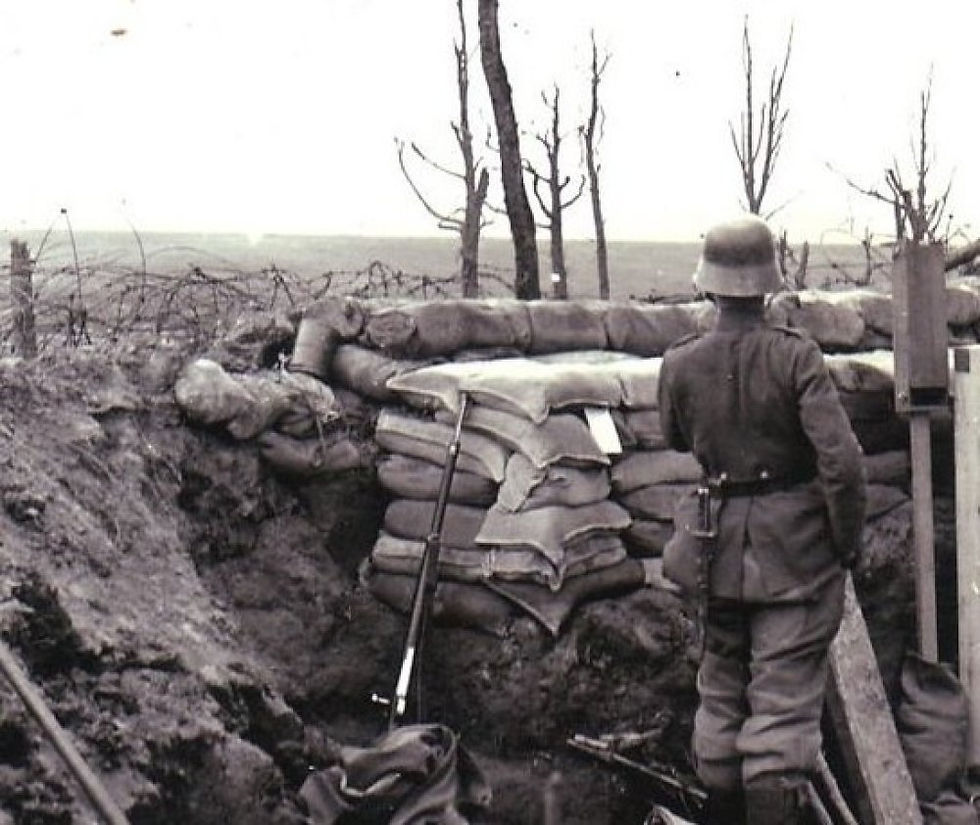
An outpost of the 13th Infantry Regiment
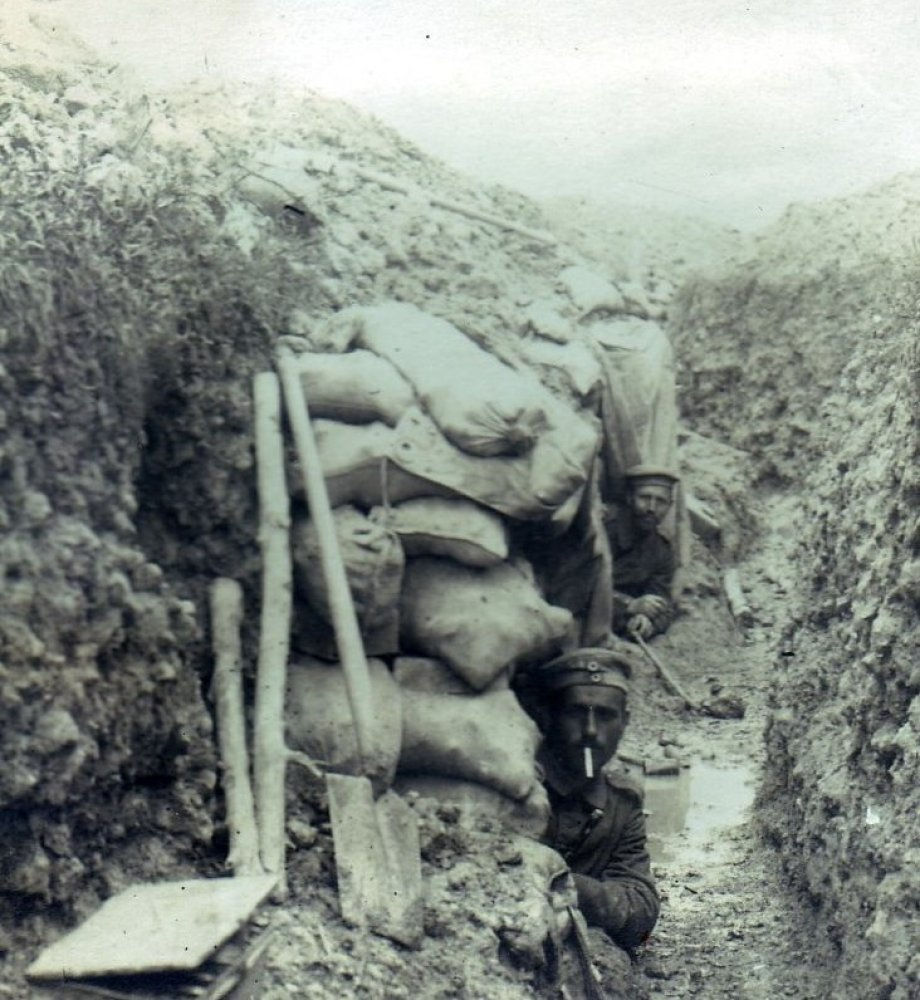
A scene from a 13th Infantry Regiment trench.

13th Infantry Regiment men in formation.
An outpost of the 13th Infantry Regiment
Arriving in Selestat days later, the 13th Regiment spent the next four weeks enjoying a break from combat while reinforcements filled its battalions to a rough strength of 210 enlisted men each. The troops enjoyed the largely untouched wine country, mountain hikes, and fresh air away from the muddy battlefields of Northern France. By September 29, however, they were forced to reboard their trains and move north to Sedan, going into the line at Monthois-Challerange to help fight off the French during the Battle of Argonne.
I Battalion moved to St. Morel taking up positions on Hill 169, east of Lirey, in the sector of the 103rd Infantry Division on September 30, 1918. The rest of the regiment arrived the next day and moved around the hill in support. French troops attacked the same day but were beat off by I Battalion in a heroic counterattack. By October 2, the battalion was sent back to St. Morel temporarily before going into a quieter defensive position while II and III Battalions supported several attacks of the 4th Bavarian Infantry Division. I Battalion remained in this rear sector until October 9 when the entire German 3rd Army began withdrawing section by section behind the Aisne as French troops broke through various parts of the line. In their new positions along the Daims Stream of the Contreuve River, the 13th Regiment watched as 175 French airplanes attacked and set aflame nearby Vouziers, demonstrating the danger of the enemy’s manpower and technological advancements.
After several days in these positions, the 13th Infantry Division was marched rearward and sent to join the Army of the Argonne, settling in a forest north of Barricourt, a German supply hub, on October 13. The men of the 13th Division, largely intact despite their few days of fighting Frenchmen, were now to face a new foe: the Americans.

NCO and infantrymen of the 13th Infantry Regiment

A fortified and reinforced position of the 13th Infantry Regiment.
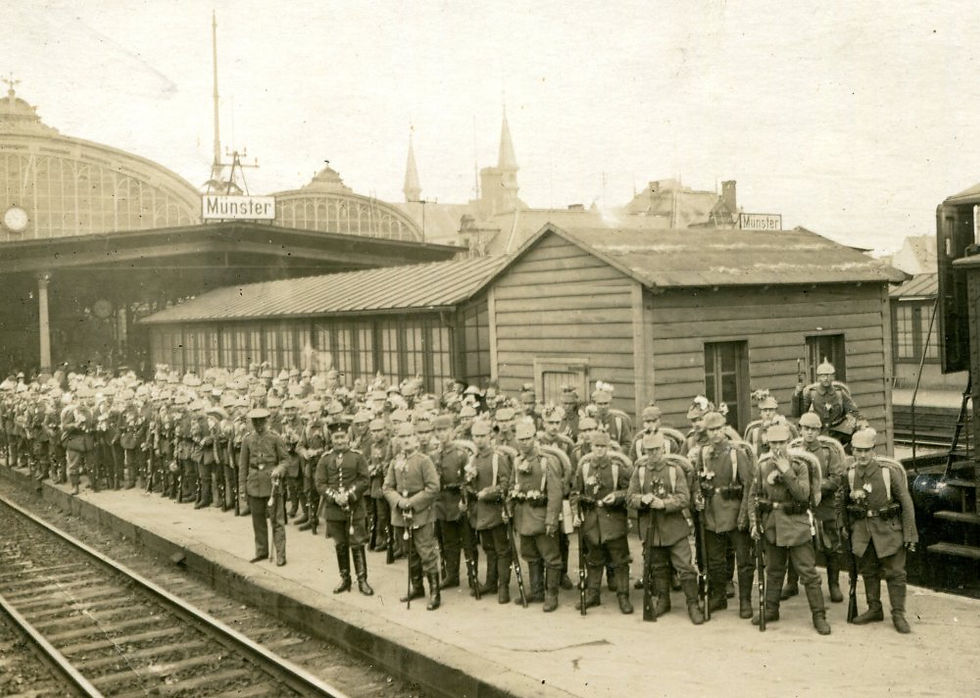
Replacements heading for the 13th Infantry Regiment
NCO and infantrymen of the 13th Infantry Regiment
On October 14, the 13th Regiment was put on alert and moved to a position just behind the German defensive line holding off the U.S. V Corps. Here, the Germans had one of their strongest positions in the Argonne: the Kriemhilde Stellung. The eastern anchor of the Hindenburg Line, the Kriemhilde was a vast series of layered trenchlines, four kilometers of barbed wire fields, concrete bunkers, little foxhole cover, and machine gun positions which ran from the village of St. Georges to Romagne-sous-Montfaucon. In the middle of this line was the impregnible Cote de Chatillon, an imposing 820-foot-high hill bristled with gun positions, bunkers, and countless other fortifications which dominated a large portion of the line. After holding off American forces for two weeks, the Cote was now being held by the 18th and 152nd Infantry Regiments of the 41st Infantry Division, experienced fighters of multiple fronts. On its right flank was the 3rd Guard Division, which Riechmann’s 13th Infantry Division was meant to replace in the coming days.
The Americans began their assault on Cote de Chatillon using soldiers of the 84th Infantry Brigade, 42nd “Rainbow” Infantry Division, commanded by none other than General Douglas MacArthur. The American troops took extreme casualties throughout the day from the machine guns of the Cote with gas and explosive artillery in support. The American 168th Infantry Regiment had the most success, taking Hill 288 in the Romagne Forest just south of the Cote before being pinned down by heavy fire. Gas attacks of the V Corps also proved effective against the weakened 3rd Guard Division on the flank, causing an entire regiment to retreat and expose the Kriemhilde Stellung to further attack.
Afraid of a possible breakthrough by the Americans, the German command ordered the 13th Regiment to move that morning into the Agron-Bach valley east of Imecourt and begin taking up positions in support of the Cote de Chatillon. III Battalion was attached directly to the 152nd Infantry Regiment on the eastern slope of the Cote, II Battalion was sent to a reserve position, and I Battalion was deployed under the 18th Infantry Regiment along the Cote’s northwestern slope and base.

The Cote de Chatillon

American soldiers of the 42nd Division attacking in the sector.

A machine gun position of the 13th.
The Cote de Chatillon
The American 42nd Division attacked once again on October 15, traversing the slopes of the Cote yard by yard. It was raining and storming, turning the Cote into a muddy quagmire laced with machine gun rounds and mortar shells as the American doughboys crawled on their bellies to advance up the hill. By the end of the day’s bloody fighting, the American 168th Infantry had gotten within a half kilometer of Musard and Tuilerie farms, two key positions on the left flank of the Cote, and taken Hill 242. The 41st Infantry Division reported back to the Argonne Command headquarters that the 13th Infantry Division was not able to relieve the 3rd Guards as originally planned, and that their soldiers were desperately needed to continue defending the Cote, especially if the left flank fell. By evening, the Americans had seized a bulk of the slopes on the Cote and held their positions in the dark. General MacArthur and his commanders gathered to strategize a final push to drive an opening in the wire on the Cote’s southern flank.
Early in the morning of October 16, MacArthur’s 167th Infantry Regiment drove through the barbed wire gap and broke into the German trenches on the southeastern slope of the Cote de Chatillon. Intense fighting ensued against the soldiers of the 18th and 152nd Infantry Regiments there and at Tuilere Farm at the base of the hill, where the American 168th Infantry Regiment had attacked from Hill 242.
At 0700, the 13th Infantry Regiment was redeployed to halt this attack. III Battalion led a counterattack against the Americans at Tuilerie Farm and managed to recapture it. I Battalion, on the left flank of the attack, moved forward until its 2nd Kompanie became exposed on its left flank. As Americans exploited the kompanie’s weakened position, it was forced to retreat, leaving 1st Kompanie and the rest of III Battalion in a difficult spot trying to hold Tuilerie Farm on their own. When the Americans repressed their attack to take the farm, the 13th was forced to retreat while a group of III Battalion stayed behind to protect them. All members of this group were either killed or captured.

Map of the 13th Infantry Regiment's involvement at the Cote de Chatillon

Assault troops of the 13th Infantry Division. These men were spread among the regiments.
Map of the 13th Infantry Regiment's involvement at the Cote de Chatillon
Around 1400, with the Americans holding the heights of Cote de Chatillon, II Battalion launched a counterattack hoping to retake it. While the battalion was able to retake the crest, it was unable to hold long before being forced to withdraw to its previous position. One of the reasons for its retreat were the actions of Medal of Honor recipient Private Thomas C. Neibaur. A Mormon from Idaho serving in M Company, 167th Infantry Regiment, 42nd Infantry Division, Neibauer was a veteran Chautchat machine gunner who had been positioned on top of Cote de Chatillon. When II Battalion counterattacked, Neibaur was hit three times and lost both of his squadmates before setting up a defensive position on a dirt berm, firing on fifty German soldiers, killing or wounding the majority of them. After his Chautcat jammed, he attempted to get away but was wounded a fourth time and captured by fifteen more Germans. When those troops hit the dirt for cover, Neibauer grabbed his 1911 pistol, killed four of them, and captured the remaining eleven. Eventually, II Battalion went down the hill and rejoined the other remnants of the 13th Regiment. That night, the entire 13th Division took over for the 3rd Guard Division in a new German line being set up along the southeast corner of the Hazois forest heading towards Bantheville.
The fighting over Tuilere Farm is one of the likely places where Riechmann’s helmet may have been lost or taken. German records denote a Wilhelm Riechmann from Drebber, Germany, who went missing that day, almost certainly taken prisoner.
With the collapse of the Kriemhilde Stellung at the hands of the Americans, the 13th Division was shifted slightly to the east. The position ran from the southeast corner of the Hazois Forest to Bantheville, through the woods west of Bantheville. The 15th Regiment had the most critical position, holding the fortified northern sector of the woods known as the Bois de Bantheville, while the 13th Regiment was made the brigade reserve to their rear and dug into a position south of Remonville. Here I and III Battalion, due to their losses at Tuilerie Farm, were combined into a single I Battalion while II Battalion largely remained unchanged.
The 13th Division was ordered to focus its efforts on the Bois de Bantheville, sending thousands of gas and explosive rounds of artillery against American soldiers of the 89th Infantry Division, who were advancing northeast in hopes of taking the woods. The artillery was highly accurate, hitting American supply routes, defensive ravines, and troop locations while disorganizing and limiting their advance. The 15th Regiment took advantage of the stall to tidy up the line with machine guns, grenade throwers, and stormtroops.

Infantrymen of the 13th Regiment in their field gear.

A German trench in the Bois de Bantheville
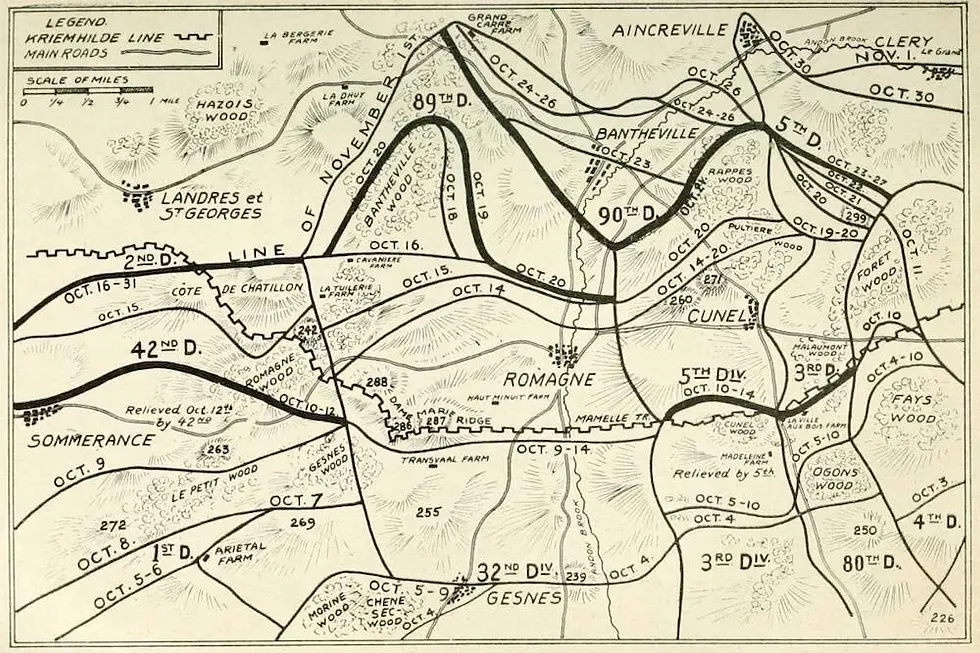
A map showing the context of the 89th Division's battle against the 13th Division in the Bois de Bantheville
Infantrymen of the 13th Regiment in their field gear.
On the morning of October 20, American troops from the 355th and 356th Infantry Regiments occupied the road west of Bantheville in the forest. The 89th Division’s orders were to clear the entirety of the Bois de Bantheville. During repeated attacks along either edge of the forest the doughboys of the 89th were met with heavy resistance, although they did manage to take one fortified hill.
The 13th Regiment was redeployed from its rear position on the morning of October 21. German artillery continued to pound the American positions in the Bois de Bantheville, however, the 15th Regiment was running low on manpower and capacity to fully defend the line. I and II Battalions of the 13th moved in, with I Battalion plugging a hole right in the middle of the forest defensive line. On their left, in the eastern side of the forest, was III/15 while II/15 took up the west. The men of I/13 were quickly thrust into the battle, spending the day fighting off Americans from the 355th and 356th Infantry Regiments trying desperately to reach the top of the forest. The Americans recalled German soldiers being everywhere, defending each ridge and bramble. Despite the best efforts of the men from Regiments 13 and 15, the Americans did slowly push them back throughout the day, but at great cost. By the end of the day’s fighting, 89th Division casualties were roughly fifty killed, 200 wounded, and twenty gassed. The Germans had taken plenty of casualties too, however.
German artillery continued to follow the American advance throughout the night, giving the 13th and 15th Regiments time to regroup at the northern edge of Bois de Bantheville for another day of vigorous defense. Parts of II/13 were regrouped to the north along the Remonville-Bantheville road to provide some kind of reserve force, but in all, the 13th Division was spread quite thin. The Americans renewed the attack that morning, capturing several of the German machine guns and mortar crews in the process. The assault intensified around 1500, driving the 6th and 7th Kompanies of the 15th Regiment on the right flank out of the woods entirely. By dark, Bois de Bantheville was all but taken. The survivors of the 13th and 15th Regiments were ordered to retreat in the darkness and move to the Freya Line, just north of the forest. Despite their best efforts, the superior size and strength of the American infantry units were simply too much for the battle-weary and deplenished soldaten. What they lost in yards, however, they forced the Americans to pay for in blood.
This battle over the Bois de Bantheville is also a plausible spot for this helmet to have been lost. Given the intensity and mobility of the battle over the forest, it would make a logical souvenir for one of the 89th Division’s doughboys who overran the I Battalion’s lines.
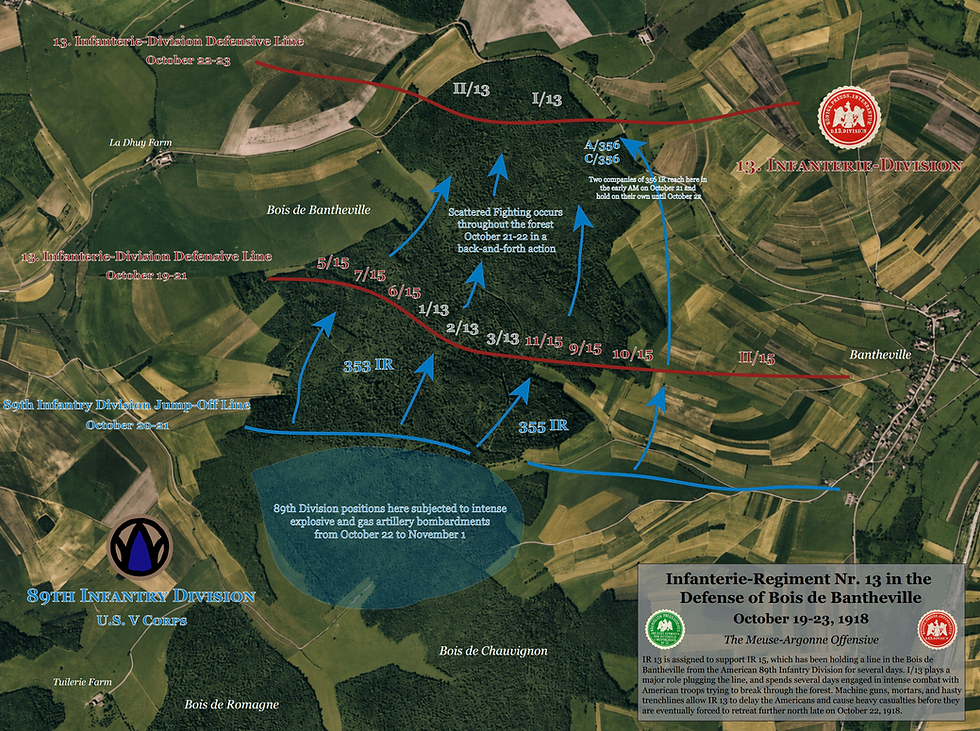
A map depicting the 13th Division's defense of the Bois de Bantheville from the 89th Division

Doughboys of the 89th Division in the Meuse-Argonne.

Doughboys of the 89th Division in the Meuse-Argonne.
A map depicting the 13th Division's defense of the Bois de Bantheville from the 89th Division
I Battalion of the 13th Regiment remained attached to the 15th Regiment on October 22, moving into a position on the southern edge of the Bois de Andevanne to take up positions along the Senta Stellung, a much less-fortified defensive line just to the north. German artillery continued to blast the Americans over the next seven days as the German troops worked to build up their defenses. Although the line was relatively quiet, the 13th Division’s manpower problem became a significant concern to German commanders. Between its three infantry regiments, the division could only boast a measly 569 men, minus the machine gun and mortar detachments. They could hold the line, but there was no hope for any offensive or counteroffensive action.
On October 29, the 13th Division was relieved by the 88th Division, which was three times the effective strength of the 13th. Moving north towards Stenay, I Battalion of the 13th Regiment traveled to Quinzy-Landzecourt where it took a break along the banks of the Meuse. The regiment took on 300 replacements during the day, dividing them out across the depleted kompanies.
The Americans launched their large final drive against the Senta Stellung early on November 1, leaving the entire front in grave danger. The 13th Regiment was immediately called up and sent south to take up positions in the woods south of Halles alongside their comrades in the 15th Regiment. Early the next morning both regiments were sent further south to the southern edge of the Bois de Tailly, southeast of Barricourt. Here they filled the line between regiments of the 28th Infantry Division. At 1500 the American attack began, with doughboys of the 90th Infantry Division attacking from the south while men from the 89th Infantry Division slowly flanked around the northern edge of the 15th Regiment to the west. Although the soldiers from the 90th Division were pushed back, the entire German force was compelled to withdraw to the northern edge of Bois de Tailly as a delaying force covered the retreat.
That night, both regiments moved back once again to an area east of Beaufort and were deployed along the Wiseppe River, along the edge of the Foret de Dieulet. Soldiers of the 13th Division recalled watching Americans from the 89th Division march across the open fields in front of them in columns with rifles slung to the side or on their backs, smoking pipes and with hands in pockets, before launching a probing attack against them in the afternoon. It was a drastic contrast to the morale and strategic situation of their German opponents. The 13th Division performed its duties, however, and drove off the 89th’s initial attacks.

Men of the 13th Regiment in a trench in late October of 1918.

A German map showing positions at the end of October once the Hindenberg Line/Kriemhilde Stellung had fallen. Note I/13 in the southern edge of the Andevanne Forest.
Men of the 13th Regiment in a trench in late October of 1918.
The 89th Division renewed its assault on the morning of November 4, pushing against the 13th and 15th Regiment’s lines at the edge of the Foret de Dieulet. The 89th Division’s history recalls that despite their orders to seize Laneuville, the division was unable to meaningfully advance against the German defenders as their artillery had not yet caught up with them. Most of the day was spent in a firefight against the German machine guns in their positions along the woods and riverbank with American casualties mounting. Around noon, however, the 13th Regiment was ordered into a rapid retreat to Laneuville. Forced to abandon their machine guns on the Wiseppe, which they attributed as the only reason for their success thus far, the regiment moved through Laneuville and on to Martincourt where they crossed the Meuse River, taking on a 500-meter sector just south of Inor. Two days later the regiment moved to a sector just south of Martincourt where it spent the final days of the war in relative quiet.
While the Americans tried to cross the Meuse several kilometers to the south, the 13th Regiment’s battle-worn infantry spent the last week of the Great War in peace. Around noon on November 11, 1918, the regiment was told that the armistice was signed and the war was over. Before long it marched back home to Munster, The regiment was defeated, but proud of what it had accomplished over the last four years of war, 11,047 casualties later.

American advances in the last week of the war. The 13th Regiment was still in the 89th Division's sector.

American advances in the last week of the war. The 13th Regiment was still in the 89th Division's sector.
American advances in the last week of the war. The 13th Regiment was still in the 89th Division's sector.
At this time, we do not know exactly who “Riechmann” was. Based on the construction and marking of this helmet, we do know he joined 4th Kompanie sometime before mid-August of 1918. The 13th Regiment’s battle history after that time is marked by its major engagements against American forces in the Meuse-Argonne Offensive. While it is unknown what American soldier brought this helmet home, he was almost certainly a doughboy of the 42nd or 89th Infantry Division, which were the final foes of the 13th Infantery Regiment for the last month of the war. This stahlhelm stands as a reminder that to every American war there was the “other side,” full of equally young and vivacious young men hoping to do their parts for their countries. Riechmann may or may have not survived the war, but he certainly wore this helmet while doing what he thought was his duty. Unfortunately for him, the GIs of Uncle Sam’s Army had other plans.

A photo from the Meuse Argonne showing a German prisoner sporting a similarly camouflaged stahlhelm.
A photo from the Meuse Argonne showing a German prisoner sporting a similarly camouflaged stahlhelm.