_edited.png)
The 36th Division Archive

Private First Class Thomas M. Daley
Scout Sniper
H Company, 3rd Battalion, 26th Marine Regiment, 5th Marine Division


Thomas Melvin Daley was born in December of 1925 to a working class family in the horse country of Lexington, Kentucky. A blue-eyed, brown-haired, freckle-faced kid, he led a rather typical childhood alongside his younger brother and sister in the rural areas of Fayette County, Kentucky, as his family lived on the outskirts of the city of Lexington. He worked as a newspaper boy in his youth for the Lexington Herald-Leader and eventually began attending Lafayette High School in south-central Lexington.


With the entrance of the United States into World War II partway through his high school career, Daley had a somewhat unique high school experience. As students dropped out to enlist, and Lexington transitioned into a manufacturing war economy, Daley did what he could to excel personally while supporting his community. As a track and basketball star, he was a rather athletic teen. As a leader of the basketball team he used his position to organize a series of community games against other local high schools to raise funds for the Lexington War Chest. Hosted by the University of Kentucky, proceeds of thes games were donated in support of the war effort, allowing the kids to do their part for victory. He was also a thespian, taking part in school plays, and kept up several jobs as a grocery store stock boy, delivering newspapers, and helping his dad with his plumbing business. Towards the end of his education, his family moved into the city of Lexington proper, off of Idlewild Court.
Daley graduated from Lafayette in May of 1944 and almost immediately decided it was time to do more for the war than play basketball. On June 27, 1944, he traveled to Louisville and enlisted in the United States Marine Corps. By June 30, he was on his way to San Diego to undergo basic training. He completed his training in August, receiving high marks on his marksmanship and earning the expert rating. Once complete, this talent for sharpshooting got him a spot at the Marine scout sniper school, where he spent September and October learning advanced tactics in sniping, reconnaissance, intelligence gathering, observation, and more. It was an advanced and difficult program, but Daley graduated and was officially designated a 761, Scout Sniper.

Daley, second from left, planning the community basketball games in support of the war effort

Daley, in jersey 33, on the Lafayette basketball team

Daley, second from left, planning the community basketball games in support of the war effort
On November 11, 1944, Daley was assigned to the 27th Replacement Draft, a loose collection of men attached to the 5th Marine Division but without an actual combat unit. Their purpose was to act as floating reserve troops that could be called upon to immediately fill the line units after combat losses during an island campaign. As such, he retained his sniper status and simply went about his duties without any particular cohesive combat unit to train with. On November 23, he shipped out alongside the rest of the division to Hawaii, onboard the USAT Kota Agoeng, arriving a little over a week later. At the end of December he went aboard the USS Athene AKA-22 along with many other men of the 27th Replacement Draft. They sailed to Saipan before joining the massive battle fleet setting off for the black sands of Iwo Jima.
As the first marines went ashore along Iwo Jima's black sands on February 19, 1945, Daley and others of the 27th Draft had to sit by and watch from their upper deck. As a draft battalion, their entire purpose was to fill the combat units as necessary. For the first week and a half of the battle, Daley participated from a distance, watching the flag raising aboard the Athene as ship horns blasted from across the entire invasion fleet. Not all the sights were so hopeful, however, as he got plenty of time to view the massed Japanese artillery and large-scale evacuation of casualties coming from the beaches.
Daley finally went ashore at the end of the month and was part of a large batch of replacement sent to the regiments of the 5th Marine Division on March 1, 1945. By this point in the battle, following its initial assault and the capture of Mount Suribachi, the division had sustained large casualties. With depleted strength, it was tasked with pushing northward against the meat of the Japanese defensive line near the unfinished Japanese airfield, Motoyama No. 3. Daley joined H Company, 3rd Battalion, 26th Marines (H/3/26) alongside two other scout snipers, Private Leland Belknap and Private Norman L. Black. Although all in H Company, they were the only three scout snipers to fight with 3/26 during the entire battle of Iwo Jima.

Men from 1st Platoon of H/3/26

A general map of Iwo Jima's defensive strongpoints
Men from 1st Platoon of H/3/26
The trio joined H Company southwest of the third airfield near Road Junction 338, a key point to maintain logistical support for their operations. Almost immediately they were shoved into the fray, but not solely as snipers. Given their superior marksmanship training, they were put into the company’s weapons teams to provide accurate designated fire support. Belknap later recalled how he was given a BAR and assigned to cover the company’s demolition and flamethrower teams, an important job given the essential nature of those two groups in clearing out Japanese caves and pillboxes. Daley was designated as a sharpshooting rifleman, but likely switched between weapons as was necessary throughout the battle.
On their first day in action, the three helped the battalion attack many of the caves and cragged hills just west of the junction in support of the 28th Marines, who were launching an assault against the major cliffside fortification known as Hill 362A. Most resistance was provided by two different units of the Japanese defenders, the 3rd Battalion, 145th Infantry Regiment and the 204th Naval Construction Battalion. The 145th fought in China during the Sino-Japanese War, but since then had mostly stayed in Japan until its deployment to Iwo Jima. As such, it was full of fresh, young, and well-trained soldiers. The 204th had played an important job designing and creating the emplacements and tunnel systems around the island, making them experts in the use of these systems to fight off the American attackers. Both units were worthy adversaries of the 26th. Despite their limited role to protect the flank of the 28th Marines, Daley’s company lost three men that day, including one of their flamethrower operators. It was immediately apparent to the three snipers that this was not going to be a clean or easy fight.

Men of the 145th Infantry Regiment on Iwo Jima

Fighting near Hill 362
Men of the 145th Infantry Regiment on Iwo Jima
Daley’s inexperience quickly vanished after he suffered the harsh reality of combat on March 2, 1945. On this day 3/26 was assigned to assault a narrow strip of the Motoyama Plateau directly west of Airfield No. 3. While the 28th Marines and 1/26 continued the assault against Hill 362A, and the 3rd Marine Division moved against the airfield itself, 3/26 was to drive a path northward along the uneven terrain beside the main road. The attack began at 0800 with H Company in the lead. As they advanced, they almost immediately ran into strong resistance. The Japanese had fortified a number of crevices and outcroppings in uneven and rocky ground, using the natural terrain as makeshift, and rather effective, bunkers. Mines were a constant problem as well, making it difficult for Daley’s battalion to get the tank support that it desperately needed. They had called in A Company of the 5th Tank Battalion, but between the mines and Japanese anti-tank guns positioned along the road, the tanks were unable to be of much help.
Left to their own devices, the infantrymen of 3/26 worked hard to repulse and destroy the Japanese defenders. As the men came across caves, demo teams and flamethrowers were called up to either blast them shut or burn them out. This made them high value targets for Japanese snipers, justifying the use of Daley and the other scout snipers to protect them. Japanese snipers were an extreme danger throughout the day, hiding themselves among the sharp black rocks to pick off the marines one by one. Belknap wrote that their ammunition was both smokeless and flashless, making it near impossible to spot them until it was too late.
The difficult situation led to many acts of heroism among the men of H Company, including one squad leader who later received the Navy Cross. During their advance up the roadway, Sergeant Raymond G. Hoffman, of Pittsburgh, Pennsylvania, led Daley and his comrades in a daring assault against the Japanese guns:
Gallantly leading his squad in a vigorous drive against an enemy position fortified by several heavy caliber gun emplacements, Sergeant Hoffman steadily approached the area against a terrific barrage of rifle, machine-gun and mortar fire, repeatedly risking his life during the advance to proceed from man to man and assure himself that each was in proper cover from the blistering fire. Seriously wounded in the shoulder by hostile rifle fire as he launched his attack, he staunchly refused to be evacuated and, striking the enemy with unrelenting fury, directed his men in four successive grenade and hand-to-hand encounters to secure the emplacements and scatter the remaining hostile troops. Concerned only for the welfare of his squad, he fearlessly penetrated the most forward areas to conduct a reconnaissance and ascertain the security of the vicinity and, while carrying out his perilous mission, was fatally struck down by a Japanese rifleman concealed near an adjacent foxhole. By his courageous leadership, indomitable fighting spirit and unwavering determination in the face of tremendous odds, Sergeant Hoffman contributed to the success of his squad in accounting for twenty-five Japanese with the loss of only one of his own men. His valiant devotion to duty throughout the fierce action was in keeping with the highest traditions of the United States Naval Service. He gallantly gave his life for his country.
Thanks to the bravery of heroes like Sergeant Hoffman, H Company was able to brave the hail of enemy fire and make meaningful progress towards their objective.

The location of the March 2, 1945, advance, where Daley was wounded.

Map showing the advance of 3/26 on March 2, 1945, where Daley was wounded
The location of the March 2, 1945, advance, where Daley was wounded.
Tragically, however, Daley was not able to make it out of the attack unscathed. Enemy mortars began pounding the battalion to try and stem their progress. Among the many casualties caused by the artillery was Daley, who was struck in the face by shrapnel during a barrage. Although he later wrote that his injury was “not serious,” it was enough for corpsmen to take him from the battle and back to the regimental aid station. By the end of the day, 3/26 had made the most progress of any unit in the regiment, clearing over 500 yards of ground.
After spending the next day and a half recovering in a field hospital, Daley decided it was time to rejoin his men in the early hours of March 4. Still bearing the fresh scar from the fragmentation that struck him, he traveled through the rain back up to the line where his company was once again clearing out caves and dense underbrush just north of where he had left them, near the ruins of a village called Kita which had once prospered before the fighting began. His battalion, working with armored bulldozer tanks, flamethrowers, and demolition teams, continued to slowly clear and close the many cave systems being used by the Japanese in the cragged and rocky terrain. By this point in the battle the 26th Marines were only at two-thirds of their initial strength, counting nearly 500 replacements, such as Daley, among the total 2,150 men. While replacements were fresh and eager to fight, they were still inexperienced and required close instruction. Some, like Daley, were wounded within hours of joining the line, demonstrating the difficulty in providing continuous leadership and experience.
Over the next three days, Daley’s battalion only progressed a short distance. Facing dozens of well-defended cave systems and strong points, the battalion was pushing against some of the strongest areas in the Japanese defensive line, requiring constant support from tanks and demolition teams to make any progress. On March 7, H Company was attached to 1/26 for a large attack through the remains of Kita to wipe out a pocket of Japanese troops that had held up the entire battalion for two days. Moving rapidly, the bolstered battalion was able to overrun the objective by 1140, allowing Daley and his comrades to begin mopping up and sealing cave entrances. It was the first major progress made in three days.
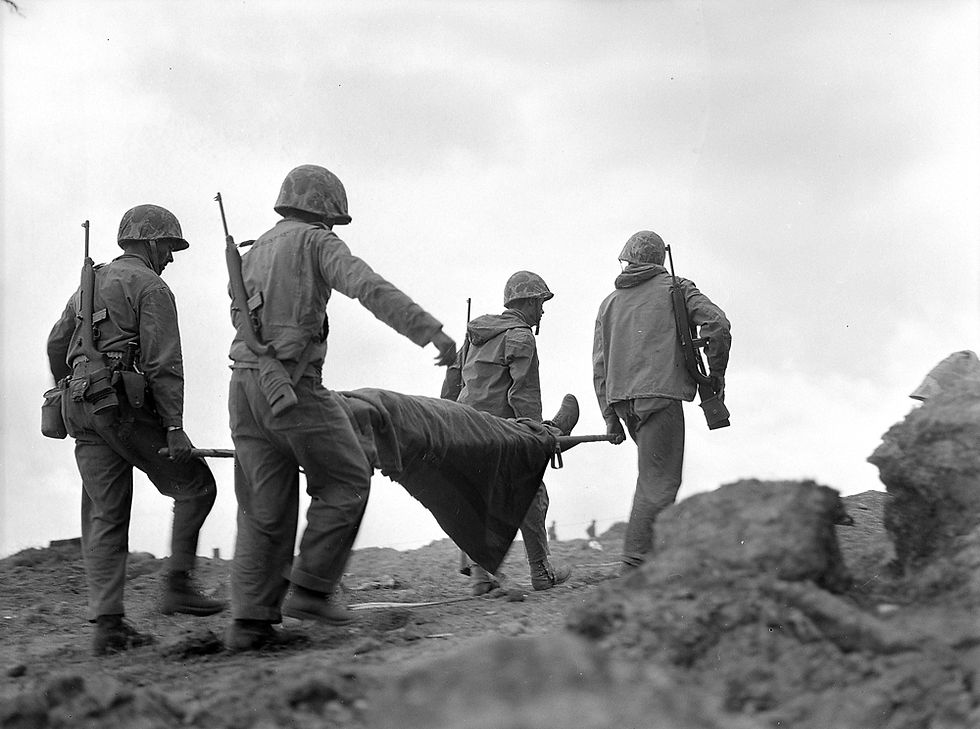
Stretcher-bearers evacuating a wounded marine.
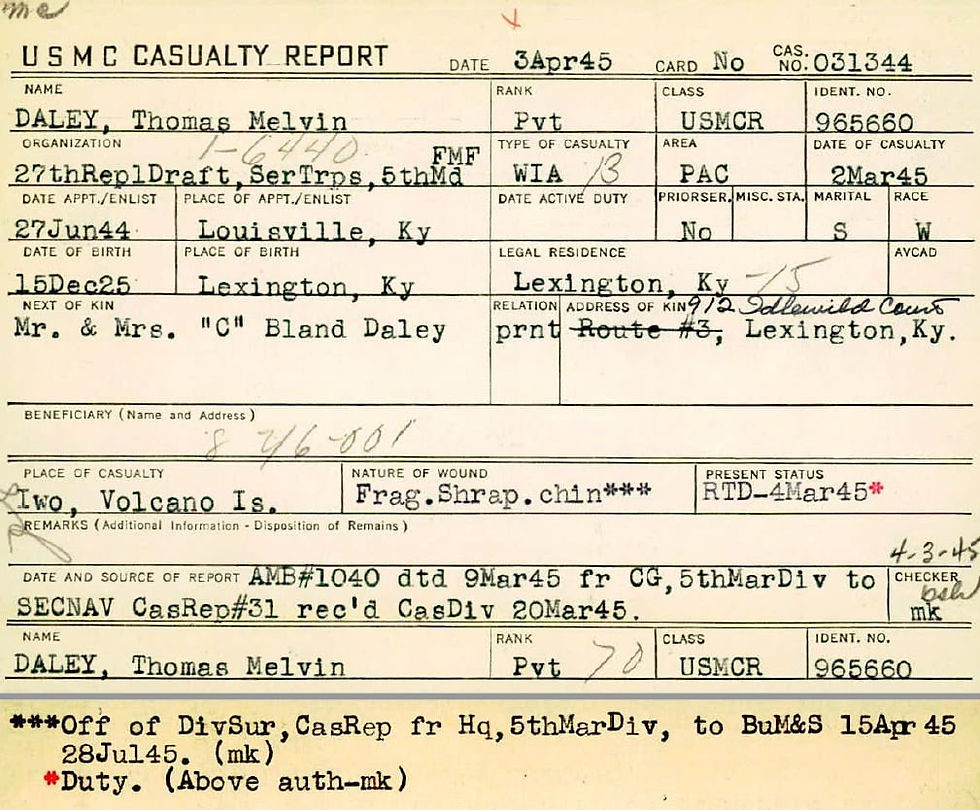
Daley's casualty card.

Announcement of Daley's wound in the Lexington Herald Leader
Stretcher-bearers evacuating a wounded marine.
Daley’s battalion ended up mostly staying in their positions northeast of Kita waiting for other marines to bring up their flanks. By this point, the 5th Marine Division was the primary combat unit pushing against the Japanese remnants. The division was reaching the northern tip of the island, where many of the surviving Japanese had retreated throughout the battle. The terrain was full of cliffs, canyons, caves, and rocky cutouts which the Japanese planned to continue making into impregnible natural fortresses. Although Daley had only been in combat for a total of seven days, he and his men were quickly becoming hard-fighting experts at overcoming these obstacles. From March 9 to 10, H Company was placed in reserve, giving the men an opportunity to rest before the northern drive began in earnest.
On March 11, 3/26 rejoined the rest of the 26th Marines and took part in a new attack northward, gaining nearly 1,000 yards. Like clockwork, the men would advance through the rocky valleys until Japanese troops opened fire. The marines would then dash into cover and wait for a Sherman dozer to move forward and blast the caves or strongpoints, or use flamethrowers to flush it out, and continue moving forward. These tactics proved the most successful in working through the difficult terrain. From March 12-13, the division was in reserve and mostly reorganized its many replacements.
3/26 led the regiment’s next big assault on the 14th, attacking with tanks and pioneers in extremely thick rocky ground. It was slow going, and over the next two days the men consciously moved cave to cave, spider hole to spider hole, working out enemy troops while the tanks trudged through. On the 17th, the 26th Marines began to swing quickly to the west, as the Japanese were collapsing towards a series of crevices, ravines, and cave systems. With loosening defenses in the north, the 26th rushed towards the northern coastline before pivoting southwest, creating a final entrapment only a thousand yards in length.

A Sherman dozer makes its way forward to support the infantry as they move against Japanese positions in the north.

An average scene going through the caves on the northern half of Iwo Jima
A Sherman dozer makes its way forward to support the infantry as they move against Japanese positions in the north.
While Daley had experienced horrendous fighting over the past three weeks, the final days of the battle were some of the most raw and brutal. Japanese forces, making last-ditch positions along a pocket of deep ravines, were turning every yard into a battle of attrition. Desperate suicide attacks, hidden traps, cave ambushes, and more plagued Daley and his comrades as they fought inch-by-inch to drive out each and every Japanese soldier lodged in their final rocky bastions. Tanks and flamethrowers did the heaviest work while demo teams sealed off cave after cave until, on March 25, 3/26 finally reached the sea. It was only a matter of time, by that point, to pick off the final pockets of resistance. By March 26, the 26th Marines were ordered to halt and load aboard the USS Golden City APA-169 to leave the black island. Daley’s combat career, and the Battle of Iwo Jima, was over.
After sustaining over 2,600 casualties, compared to an initial assault force of just over 3,000, the 26th Marine Regiment was permitted to leave immediately for Hawaii for rest and reorganization. Although for most of the men this was the last time they would ever see the island, the things they had witnessed there remained in their memories forever. “The memories do linger,” recalled Private Robert Gasche, one of Daley’s company-mates who had also been wounded on the March 2 attack, “but you just have to cope with that.”

A flamethrower team clears enemy caves on the northern tip of the island
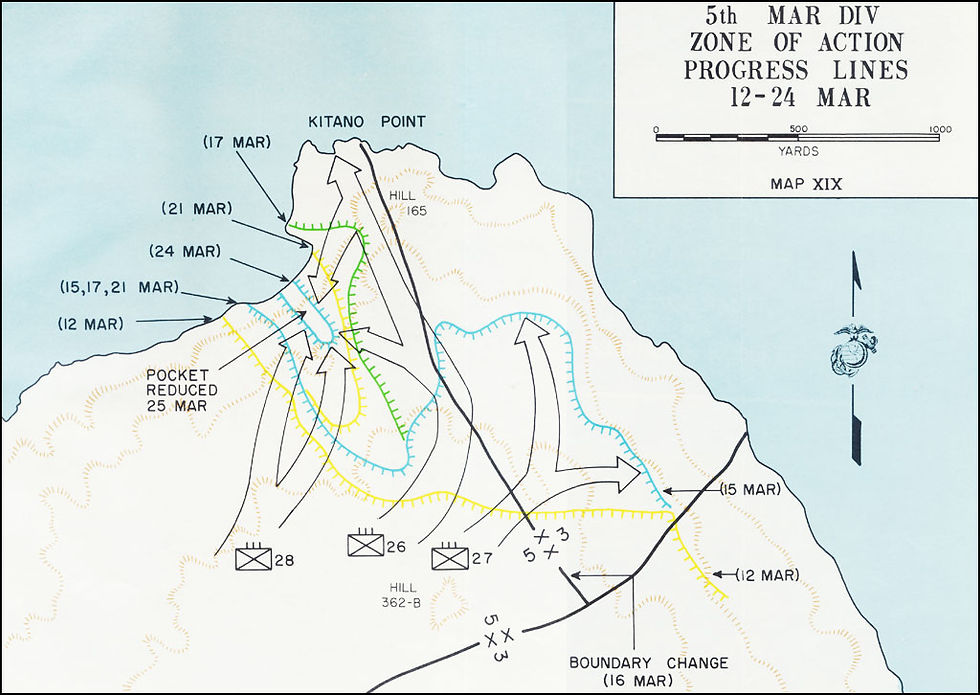
The final drive of the 5th Marine Division

Mopping up operations near the coastline
A flamethrower team clears enemy caves on the northern tip of the island
The 26th landed in Hawaii on April 15, giving Daley some time to rest and process his experiences. He was promoted to Private First Class while encamped there and even made time to meet up with some old friends from Lexington. He got together with Private Robert E. Blankenship and Private Porter Welch, both also in the 5th Marine Division, sharing memories of home and posing for a photograph with a captured Japanese flag which Blankenship had taken from a Japanese captain on Iwo Jima. It was a bright moment of reunion for the trio who had just endured hell on Earth.
Once it was announced that the war was finally at an end in August of 1945, Daley was able to celebrate, but only for a short while. On August 23, he and the 26th Marines embarked aboard the USS Bowie and sailed for Japan, arriving at Kyushu to begin occupation duties. Still a designated scout sniper, Daley’s talents with a rifle were put to use on guard duty. He was not exactly as sharp as he had once been, however, as he was once reprimanded for “unmilitary conduct” after being caught sitting down while serving as a sentry. In October he traveled once again, this time to Peleliu, for further occupation. He remained on the island until March when he was transferred again to Guam. At the same time, Daley got word that his younger brother had decided to enlist in the Army Air Corps.
Daley and his parents were growing frustrated with his lengthy occupation assignments. Despite his wound, Daley had never received his Purple Heart medal and was therefore stuck with a lower “point” number which was keeping him from going home. His mother, frustrated, sent a letter to the President of the United States and Commandant of the Marine Corps asking why the medal had never been awarded and why he was being forced to remain overseas. The Corps quickly corrected the mistake, awarding Daley his Purple Heart in April, but took another two months and two letters from Mrs. Daley to finally schedule his trip home. Daley left Guam on June 28 and was formally discharged from the Marines out of Camp Lejeune on July 24, 1946.

The photo taken on Hawaii, later reprinted in the Lexington Herald Leader. Daley is on the right, Blankenship is on the left, and Welch is in the middle.

One of the letters sent by Mrs. Daley about his Purple Heart and return home.

One of the letters sent by Mrs. Daley about his Purple Heart and return home.
The photo taken on Hawaii, later reprinted in the Lexington Herald Leader. Daley is on the right, Blankenship is on the left, and Welch is in the middle.
It was a great joy for the Daleys when he finally returned to Lexington, although the excitement of the victory had largely worn off among the city’s residents, making it a quiet and personal homecoming. After some time working, and reenlisting in the reserves, Daley decided to utilize the G.I. Bill by pursuing a degree in mechanical engineering at the University of Kentucky, which he received in 1950. He moved back in with his family on Idlewild Court and began working for the local branch of a Cleveland engineering firm.
In 1952, Daley proposed and was married to his lifelong bride, Louise Long, and began a family which produced four children. The family remained in Lexington for another ten years before Daley’s mechanical engineering career demanded on-site travel. He worked on engineering projects across the country before settling in Nashville in the 1980s, helping on the Minute Man missiles, several NASA projects, as well as the thermal plant and Tennessee Performing Arts Center in Nashville, just to name a few. He was an active civic leader in ASHRAE, the Tennessee Society of Professional Engineers, Boy Scouts of America, and UK’s Alumni Association. A proud Marine, he was always active in local chapters of the VFW and kept his wartime dress uniform slung up in his closet for over fifty years.
Daley passed away in September of 1999, but was buried back home in Lexington, Kentucky. To this day, the Eagle, Globe, and Anchor of the United States Marine Corps is proudly etched above his epitaph.

Daley and his uniform, reunited.

Daley's obituary.
Daley and his uniform, reunited.